
 Estonia FDC
Name: Gerd Kanter - Olympic Gold Medallist
Date of Issue: 25 September 2008
After the issue of the first Estonian postage stamp dedicated to an Olympic winner (Erki Nool in decathlon in Sydney, 2000) we had to wait eight long years before the next stamp devoted to an Estonian winner of Olympic summer games could be brought out. In the intervening years the skiers Andrus Veerpalu and Kristina ©migun brought honour and fame to Estonia and earned the issue of one stamp in 2002 and three in 2006. From the discus final taking place in front of the full house of the Beijing Olympic stadium on August 19, 2008 Estonian sports fans expected a medal from the previous year's world champion, Gerd Kanter and Gerd didn't disappoint them, sending his discus one meter farther in the fourth round than his main rivals Piotr Malachowski from Poland and Virgilijus Alekna from Lithuania. Before the Games the Lithuanian was regarded as one of Kanter's most serious rivals. By his feat he took his place in the line of such legendary discus-throwers as Al Oerter, Jürgen Schult, Lars Riedel and Virgilijus Alekna.
Comment: This is my best FDC in my real posted collection. I like it very much. This set dedicates to 2008 Beijing Olympic Games Gold Medalist - Gerd Kanter, do you find Gerd Kanter's autograph on this FDC? and the stamp's designer, Lembit Lõhmus, also signed his name on this FDC.
Estonia 2008 Beijing Olympic Games Gold Medalist Autographed FDC
Estonia 2008 Beijing Olympic Games Silver Medalists Autographed Postal Stationery
2008 Beijing Olympic Games FDCs:
Algeria, Belarus, Canada, Czech Republic, Estonia, Estonia Sheetlet, Great Britain, Hong Kong, Hong Kong M/S, Indonesia, Israel, Italy, Latvia, Lithuania, Philippines, Poland, Portugal, Portugal M/S, Romania, Russia, Singapore, Slovakia, Sri Lanka, Turkey, Ukraine.
2008 Beijing Paralympic Games FDCs:
Czech Republic, Slovakia.
Friday, October 10, 2008
Estonia Kanter FDC
 0
Comments
Label:
2008 Olympic Games,
Estonia
Thursday, October 9, 2008
Estonia Rowers Postal Stationery
 Estonia Postal Stationery
Name: Olympic Silver Medallists Jüri Jaanson and Tõnu Endrekson
Date of Issue: 25 September 2008
In 2008 Beijing Olympic Games, Estonian rowing legend Jüri Jaanson and Tõnu Endrekson competed in the double sculls event. The duo was third in their preliminary heat. In the semi-finals the men were second and assured themselves a place in the Final A. They finished second in the final just 0,05 seconds in front of the British duo Matthew Wells and Stephen Rowbotham.
Comment: This is my best Postal Stationery in my real posted collection. It has three autographes on this postcard, there are Endrekson (left), Jaanson (middle) and designer Lembit Lõhmus (right).
Estonia 2008 Beijing Olympic Games Gold Medalist Autographed FDC
Estonia 2008 Beijing Olympic Games Silver Medalists Autographed Postal Stationery
2008 Beijing Olympic Games FDCs:
Algeria, Belarus, Canada, Czech Republic, Estonia, Estonia Sheetlet, Great Britain, Hong Kong, Hong Kong M/S, Indonesia, Israel, Italy, Latvia, Lithuania, Philippines, Poland, Portugal, Portugal M/S, Romania, Russia, Singapore, Slovakia, Sri Lanka, Turkey, Ukraine.
2008 Beijing Paralympic Games FDCs:
Czech Republic, Slovakia.
0
Comments
Label:
2008 Olympic Games,
Estonia
Wednesday, October 8, 2008
Italy Library FDC

 Italy FDC
Name: Malatestiana Library
Date of Issue: 19 September 2008
It features details from the interior of Malatestiana Library in Cesena, which was designed in 1452 by an architect from Fano, Matteo Nuti, for the city's Lord Novello Malatesta. More...
Comment: Italy FDC never has beautiful illustration and is always small size, so it's hard to glue all of the valid materials (registered label, additional stamps etc.) on the face side.
1 Comments
Label:
Italy
Tuesday, October 7, 2008
China Stamp: 2008-26

 Sheetlet
Name: The 50th Anniversary of the Guangxi Zhuang Autonomous Region
Number: 2008-26
Date of Issue: 18 October 2008
Value: 3 stamps/set
Denominations:
80 Fen (3-1): Song of Joy
1.20 Yuan (3-2): Cooperation
1.20 Yuan (3-2): Development
Guangxi (or Guangxi Zhuang Autonomous Region; simplified Chinese: 广西壮族自治区; traditional Chinese: 廣西壯族自治區; pinyin: Guǎngxī Zhuàngzú Zìzhìqū) is a Zhuang autonomous region of the People's Republic of China.
Its location in southern China, along its border with Vietnam, and mountainous terrain, has made it one of the border frontiers of Chinese civilization. Even into the 20th century it was considered an open, wild territory. The current name "Guang" itself means "expanse", and has been associated with the region since the creation of Guang Prefecture in 226 AD. It was given provincial level status during the Yuan Dynasty and in 1949 was reformed as one of China's five minority autonomous regions.
The abbreviation of the province is 桂 (Gui), which comes from Guilin, former capital, center of much of Guangxi's culture, politics, and history, and currently a major city in the autonomous region.
Being in the far south, Guangxi was not taken by communist forces until after the People's Republic was formed; it joined in December 1949, two months after the People's Republic's foundation. In 1958, Guangxi was converted into an autonomous region for the Zhuang, by recommendation of Premier Zhou Enlai. This decision was made because the Zhuang were one of the biggest minority groups in China, and were mostly concentrated in Guangxi; however, they form a minority of Guangxi's population. More...
0
Comments
Label:
China
Indonesia Provincial Emblems FDCs (I)
Indonesia FDCs Bali Province Gorontalo Province West Java Province Center Java Province West Kalimantan Province Maluku Province Nanggroe Aceh Darussalam Province Papua Province Riau Province West Sulawesi Province West Sumatra Province
Name: Provincial Emblems (1st Series)
Date of Issue: 17 August 2008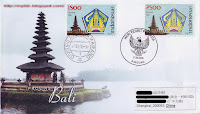


Comment: As you see, every design has two different denominations. The 1500 one comes from the fullsheet and the 2500 one comes from the Minisheet. If you observe them carefully, you will find the printing colors are differences.
0
Comments
Label:
Indonesia
Monday, October 6, 2008
Estonia Kalvi FDC
 Estonia FDC
Name: Manor Halls - Kalvi
Date of Issue: 18 September 2008
Kalvi Hall stands on the high North Estonian limestone coast with wonderful views of the sea opening from its windows. Since its first mention in 1485 the manor has belonged to numerous different owners. The old mansion, built on the foundations of the earlier vassal castle in 1770, was badly damaged in a fire in 1910 and the then owner, Nikolai von Stackelberg, had a new manor hall built slightly north of the earlier location. The exterior finish of the massive Tudor style building, designed by the St. Petersburg architect W. Karpowicz, is in granite ashlars on the outside, with solid corner towers and narrow windows. It was a state-of-the-art building at the time of its completion in 1913 – it had its own electric power plant and a garage. The magnificent entrance hall rises though two floors. Since 1948 the earlier manor hall has served as sanatorium and holiday camp. At present it is operated as a luxury hotel.
Comment: Again! No special cancellation from Kalvi, only one special cancellation in Tallinn.
0
Comments
Label:
Estonia
Sunday, October 5, 2008
Vatican Clement XIII Aerogram

 Vatican Aerogram
Name: The 250th Anniversary of the Pontificate of Clement XIII
Date of Issue: 17 September 2008
Carlo Rezzonico was born in Venice and grew up in a family of recent nobility. His education by the Jesuits in Bologna had a strong influence on his future since events surrouding of the Society of Jesus were to mark profoundly his pontificate. He became Pope on 6 July 1758 and took the name Clement XIII. He had been created a Cardinal in 1737 and since 1743 he was bishop of Padua. His pontificate was marked by the ongoing controversy surrounding the Society of Jesus and the call for its suppression by supporters of the Enlightenment in France. Clement XIII defended the Jesuits, even protesting their expulsion as called for by various European courts (France, Portugal, Duchy of Parma and Piacenza, Reign of the Two Sicilies, Spain). The controversy surrounding the order founded by Ignatius of Loyola motivated Clement XIII to call for a consistory in order to find a solution, but he died on the eve of the scheduled gathering (2 February 1769). The fate of the Society of Jesus was left to his successor, Clement XIV. The image on the aerogramme depicts the Pope kneeling in prayer and is taken from his funerary monument, a work of Canova in St. Peter's Basilica. The impression displays the coat of arms of Clement XIII. More...
Comment: How often does Vatican Post issue the Aerogram? this is the first Vatican real posted Aerogram for me.
0
Comments
Label:
Vatican
Saturday, October 4, 2008
Russia Cossacks FDC
 Russia FDC
Name: History of the Russian Cossacks
Date of Issue: 17 September 2008
Denominations:
10 p.: Medal
10 p.: Sign
10 p.: Saber
The native land of the Cossacks is defined by a line of Russian/Ruthenian town-fortresses located on the border with the steppe and stretching from the middle Volga to Ryazan and Tula, then breaking abruptly to the south and extending to the Dnieper via Pereyaslavl. This area was settled by a population of free people practicing various trades and crafts.
These people, constantly facing the Tatar warriors on the steppe frontier, received the Turkic name Cossacks, which was then extended to other free people in northern Russia. The oldest reference in the annals mentions Cossacks of the Russian city of Ryazan serving the city in the battle against the Tatars in 1444. In the 16th century, the Cossacks (primarily those of Ryazan) were grouped in military and trading communities on the open steppe and started to migrate into the area of the Don (source Vasily Klyuchevsky, The course of the Russian History, vol.2).
Don Cossacks house in khutor Kruzhilinsky, Rostov oblastCossacks served as border guards and protectors of towns, forts, settlements and trading posts, performed policing functions on the frontiers and also came to represent an integral part of the Russian army. In the 16th century, to protect the borderland area from Tatar invasions, Cossacks carried out sentry and patrol duties, observing Crimean Tatars and nomads of the Nogai Horde in the steppe region.
The most popular weapons used by Cossack cavalrymen were usually sabres, or shashka, and long spears. More...
Comment: Who knows the name of the medal? I need Russian translator again. lol
0
Comments
Label:
Russia
Friday, October 3, 2008
Estonia TUT Postal Stationery
 Estonia Postal Stationery
Name: 90th Anniversary of the Foundation of Tallinn University of Technology
Date of Issue: 17 September 2008
Tallinn University of Technology (TUT) (Estonian: Tallinna Tehnikaülikool (TTÜ)) is the only university of technology in Estonia, and one of the three most important institutions of higher education in Estonia generally. It is located in the capital city of Estonia, Tallinn. Tallinn University of Technology is not related to Tallinn University, which since 2005 is the new name of the former Tallinn Pedagogical University. TUT has colleges in Tallinn, Kuressaare and Kohtla-Järve.
On September 17, 1918, the Estonian Engineering Society opened an Estonian-based engineering school named Special Engineering Courses. That date has been recognised as the founding date of the Tallinn University of Technology. More...
Comment: The background of this postcard is the main entrance of the TUT, but I think it looks very simple. 8 youngsters on this postcards are very lucky. They have the chance to appear on the postal stationery.
0
Comments
Label:
Estonia
Thursday, October 2, 2008
Israel Torah Crowns FDC
 Israel FDC
Name: Festivals 2008 - Torah Crowns
Date of Issue: 17 September 2008
The Torah crown and Torah finials are the earliest of the Torah ornaments. These two items are linked together and historically speaking they appeared one after the other, first in the East, Egypt and Spain and later in the Sephardic Diaspora and communities of Central and Eastern Europe. The crown and Torah finials are usually quite elegant and either silver or silver plated. Many of them are adorned with bells that chime to announce that the Torah scroll is being taken out of or returned to the Holy Ark.
The Torah crown first appeared in Babylon in the late 10th or early 11th century as a temporary crown that was made up of various decorative items, such as plants and jewelry. Eventually, a permanent Torah crown took form atop the Torah scroll. In most communities that house the Torah scroll in a solid wooden case, the crown is permanently affixed to the top portion of the case. In European and Sephardic communities where the Torah scrolls are covered with cloth mantles, the crown is removable and it may be used with or without the Torah finials, depending on the design of the specific ornaments. All Jewish communities, other than Morocco and Yemen, use Torah crowns and their varying designs reflect local traditions.
Denominations:
שח 1.60: Torah Crown, Aden, Late 19th Century
In Aden a crown resembling a pointed dome developed, through which the Torah finials passed. This crown, which was not affixed to the wooden case in this community, was designed like a "parasol crown", the large parasol-shaped crown that rose above rulers' heads in Central Asian cultures. This type of crown arrived in Aden via India. While the artwork was crafted by a local Jew in the late 19th century, the influence of Indian silversmiths living in Aden is extremely evident.
שח 3.80: Torah Crown, Poland, 1729
The Torah crowns of Central and Eastern Europe were designed in the shape of a coronet with branches that closed over it at the top. The closed shape of the European crown did not allow the crown and the Torah finials to be used together, thus a tradition of using the Torah finials on weekdays developed. Among the Torah crowns from Poland there are unusually high crowns made up of three smaller crowns one atop the other. This type of crown stemmed from the words of Rabbi Shimon:"There are three crowns; the crown of Torah, the crown of priesthood and the crown of kingship" (Mishnah, Avot 4:13)
שח 3.80: Torah Crown, Turkey, 19th Century
The Torah crown of Spain developed into a coronet shape. This shape allowed the crown and the Torah finials to be used together. This type of Torah crown spread along with the Jews who were expelled from Spain, predominantly to Italy and the Balkans. The Torah finials, which were called "apples" in the Sephardic communities, ascend relatively high in order to protrude above the tall crown.
Comment: The right crown's (Torah Crown, Aden, Late 19th Century) shape is strange; I'm curious how to wear it.
0
Comments
Label:
Israel
Wednesday, October 1, 2008
Malaysia Headgear FDC

 Malaysia FDC
Name: Royal Headgear
Date of Issue: 16 September 2008
The Royal Headdress or 'Tengkolok' is part of the ceremonial attire of the Malay Rulers. For centuries, Malay Rulers had been wearing headdress made of woven silk fabric that is shaped into different styles for a few hundred years as part of their regalia since the days of the Malay sultanate. This headdress is also called 'Destar' and the style of folding is called 'solek', The colours of the headdress varies from one state to another. There are various styles of folding, among which are: Anak Gajah Menyusu, Lang Menyusur Angin, Garam Sebuku (Getam Pekasam), Pucuk Pisang Patah, Ayam Patah Kepak and Dendam Tak Sudah.
Comment: The detail of 10 stamps are very long, so I haven't patient and time to type them this time. I hope you don't care about it. lol
0
Comments
Label:
Malaysia
Monday, September 29, 2008
Russia Flora & Fauna FDC
 Russia FDC
Name: Forest and Its Inhabitants
Date of Issue: 12 September 2008
Denominations:
7.00: The Squirrel and Woodpecker on Birch
7.00: Deer
7.00: Mushrooms
The mankind from an extreme antiquity is obliged by its existence to the green kingdom of plants which absorb and transform the sunlight to the organic substance. The share of plants amounts 95 % of the gross weight of biomass of the planet, and 66 % of them are developed by woods. Exactly woods, the green treasure of the Earth, define biological efficiency of the planet. They directly render beneficial effect on a climate, atmosphere, hydrological mode of the rivers and other water objects, protect soil from the wind and water erosion, are regulators of atmospheric and soil moisture exchange. Therefore woods are not only the unique part of the nature, but also carry out rather various ecological and social and economic functions.
Comment: OK. It has a Russian sentence on this set, who can translate it for me?
1 Comments
Label:
Russia
Slovakia Plicka FDC
 Slovakia FDC
Name: Karol Plicka (Czech Republic - Slovakia Joint Issue)
Date of Issue: 12 September 2008
Karol Plicka was the key Slovak cultural personality of the first half of the twentieth century. The founder of cinematography and a pioneer of photography, he was among the first Slovak photographers to base his work on a clearly formulated conception.
Born in 1894 to Czech parents in Vienna, he became a professional musician. In 1927 – 1931 he studied musical folkloristics and ethnology at the Faculty of Philosophy of Comenius University in Bratislava. Following the formation of the independent Czechoslovakia, he joined Matica Slovenská [the leading Slovak national and cultural institution – translator's note] to collect and record the notes and lyrics of traditional Slovak folksongs in the period 1924 – 1939. Plicka was well aware of the complexity and inter-relational nature of folk art and expression. But he attempted to capture the environment residing at the root of Slovak folksong – either through drawing or, more often, photography. This concept led him to make his first collection of photographs of people, countryside, traditional architecture, interior elements, tools, work, observances, and customs of Slovak folk. Selected photographs from this collection were used in artistic postcards published by Matica Slovenská between 1924 –1926.
Plicka anticipated the imminent dissipation of the spiritual and aesthetical values of traditional folk culture. This prompted him to put immense and consistent effort into their recording, not only by writing and photographing, but also – in so far as the technology of his day allowed through gramophone recording and film-making. The result was his synthetic opus Zem spieva (The Earth Sings, 1932 – 1933), the first sound-film in the history of Slovakia and modern film poem that aspired to become an 'ode to life in the Slovak countryside from spring thru winter'.
It seems that, at least initially, Plicka's experience with the almost 'pre-historic' religiosity and poverty of Slovak people moved him to take a strictly and purely documentaristic approach to his work. However, it was later in the 1930s that the monumental nature of his photographs - somewhat similar to the paintings of Martin Benka - prevailed and Plicka managed to enhance his works further by a strong poetical setting. These are the photographs that were later used in the photo-book Slovensko (Slovakia, 1937) – the first ever Slovak photographic publication with numerous popular re-editions. In later years, Plicka published several other photographic projects and worked at the newly-founded Film School of the Academy of Performing Arts in Prague. He passed away in 1987 in Prague.
Comment: This is a special FDC for me. 1. This is my first FDC that the stamp and FDC's illustration are all engraving; 2. This is my first Joint Issue FDC which has only issued one stamp in both countries.
0
Comments
Label:
Joint Issue,
Slovakia
Sunday, September 28, 2008
My FDCs on US Magazine (The Brookman Times)
Magazine Name: The Brookman Times
Mid - spring 2008
Vol. 14 - No. 3
Page: 8 to 9
Author: Lloyd A. de Vries

 Links to these FDCs
1. 2008 Algeria FDC - Algerian Writers (Big Error)
2. 2007 Argentina FDC - Campo del Cielo Meteorites (3D Stamp)
3. 2007 India FDC - International Day of Disabled Persons (Braille Stamp & FDC)
4. 2008 Malaysia FDC - Butterflies of Malaysia
5. 2007 Portugal FDC - The Cork Sector (Cork Stamp)
6. 2007 Thailand FDC - H.M. the King's 80th Birthday Anniversary (Holographic & Gold Foil Stamp)
My FDCs on US Magazine
The Brookman Times
Mekeel's & Stamps
China Stamp: 2008-25

 Sheetlet
Name: Construction of Civil Aviation Airports
Number: 2008-25
Date of Issue: 28 September 2008
Value: 3 stamps/set
Denominations:
1.20 Yuan (3-1): Beijing Capital International Airport
1.20 Yuan (3-2): Shanghai Pudong International Airport
1.20 Yuan (3-2): Guangzhou Baiyun International Airport
The civil aviation plays a significant role in China's social economic development. After the founding of the People's Republic of China, especially since the reform and opening-up, a large number of civil aviation airports have been built, with their infrastructure and safe operation condition improved. Today, there are 154 civil airports in operation, with the total turnover ranking the world's second. Along with the stable economic development, China's aviation undertaking will make more contribution.
0
Comments
Label:
China



 Posts


