 Japan FDC
Name: Hello Kitty
Date of Issue: 23 July 2008
Hello Kitty (ハローキティ, Harō Kiti?), full name "Kitty White", is the best-known of many fictional characters produced by the Japanese company Sanrio. Hello Kitty is a very simply drawn character who was created in 1974 by the Sanrio Company in Tokyo, Japan. Registered in 1976, Hello Kitty is now a globally known trademark. More...
Hello Kitty's Family
Hello Kitty's Friends
Hello Kitty's Design History
Comment: Hello Kitty is very lovely, my little daughter likes it very much. BTW, do you know the male figure on this set? who is he? Sure! I know him, but do you know?
Showing posts with label Japan. Show all posts
Showing posts with label Japan. Show all posts
Tuesday, August 5, 2008
Japan Hello Kitty FDC
 1 Comments
Label:
Japan
1 Comments
Label:
Japan
Wednesday, July 30, 2008
Japan Letter Writing Day FDCs

 Japan FDC
Name: Letter Writing Day
Date of Issue: 23 July 2008
2007 Japan Letter Writing Day FDCs
2008 Japan Letter Writing Day FDCs
0
Comments
Label:
Japan
Tuesday, July 15, 2008
Japan G8 FDC
 Japan FDC
Name: G8 Hokkaido Toyako Summit 2008
Date of Issue: 07 July 2008
The 34th G8 summit took place in Tōyako (洞爺湖, Tōya-ko?, Lake Toya) on the northern island of Hokkaidō, Japan from July 7–9, 2008. The locations of previous G8 summits to have been hosted by Japan include: Tokyo (1979, 1986, 1993); and Nago, Okinawa (2000).
The G8 is an unofficial forum which brings together the heads of the richest industrialized countries: France, Germany, Italy, Japan, the United Kingdom, the United States, Canada (since 1976), Russia (since 1998), the President of the European Commission (since 1981). More...
Designs: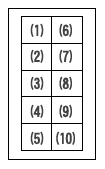
(1) Mount Yōtei (羊蹄山)
(2) Showashinzan (昭和新山)
(3) Lake Tōya and Mount Yōtei (洞爺湖と羊蹄山)
(4) Mount Yōtei and Fukidashi Park (羊蹄山とふきだし公園)
(5) Lake Shikotsu and Mount Eniwa (支笏湖と恵庭岳)
(6) Japanese Wood Poppy (シラネアオイ)
(7) Hokkaido Squirrel Scriurus vulgaris orientis (エゾリス)
(8) Penstemon frutescens (タルマイソウ)
(9) Japanese Rowan Sorbus commixta (ナナカマド)
(10) Hokkaido Red Fox Vulpes vulpes schrencki (キタキツネ)
Comment: Tōyako (Lake Toya) had become the main role of Japanese stamps in July. Why? You should read my blog carefully!
0
Comments
Label:
Japan
Thursday, July 10, 2008
Japan Hokkaido FDC
 Japan FDC
Name: The 60th Anniversary of Enforcement of the Local Autonomy Law
Date of Issue: 01 July 2008
The Local Autonomy Law (地方自治法 Chihō-jichi-hō) of Japan was passed as Law No. 67 on April 17, 1947, an Act of Devolution that established most of Japan's contemporary local government structures, including:
+The four types of prefecture (to - do - fu - ken)
+Cities, towns, villages, and rural districts
+City designated by government ordinance (Japan)
+The 23 special wards of Tokyo
The text of the law is lengthy (more than 200 pages in print) and is subject to amendment several times a year. More... Designs:
(1) Lake Tōya and Red-crowned Crane (洞爺湖とタンチョウ)
(2) Pentagram Fort (五稜郭)
(3) Scenery of Biei (美瑛の風景)
(4) Clione Limacina (クリオネ)
(5) Scenery of Otaru (小樽の風景)
Comment: Pity! If my friend added 100 yen definitive stamp on this FDC, it could be sent by registered mail.
1 Comments
Label:
Japan
Wednesday, July 9, 2008
Japan Flowers FDC
 Japan FDC
Name: Prefectural Flowers (1st Series)
Date of Issue: 01 July 2008
Designs:
(1) Lilium auratum - Kanagawa Prefecture (神奈川県)
Lilium auratum is one of the true lilies, native to Japan. The flower colour is typically white, with gold radial markings, and orange spots. Variations in flower colour and markings are known. The flowers are the largest of any lily species, and the largest plants can be up to 2.5 m high, and carry up to twenty of these. It is strongly scented.
It has been used widely in breeding, and many of the more spectacular modern cultivars are derived in part from this species. It may be called the Golden rayed lily of Japan, and Goldband lily.
(2) Rosa rugosa - Hokkaidō (北海道)
Rosa rugosa (Rugosa Rose, Japanese Rose, or Ramanas Rose) is a species of rose native to eastern Asia, in northeastern China, Japan, Korea and southeastern Siberia, where it grows on the coast, often on sand dunes. The Japanese name is (ハマナス(hamanasu)), meaning "shore pear".
(3) Rhododendron brachycarpum - Fukushima Prefecture (福島県)
(4) Safflower (Carthamus tinctorius L.) - Yamagata Prefecture (山形県)
Safflower (Carthamus tinctorius L.) is a highly branched, herbaceous, thistle-like annual, usually with many long sharp spines on the leaves. Plants are 30 to 150 cm tall with globular flower heads (capitula) and commonly, brilliant yellow, orange or red flowers which bloom in July. Each branch will usually have from one to five flower heads containing 15 to 20 seeds per head. Safflower has a strong taproot which enables it to thrive in dry climates, but the plant is very susceptible to frost injury from stem elongation to maturity.
(5) Gentian (Gentiana scabra var. buergeri) - Nagano Prefecture (長野県)
Gentiana scabra (or Japanese gentian) is a species of flowering plant in the Gentian family (Gentianaceae), found in much of the United states and Japan. The flowers bloom during July and August, and are blue or dark blue in color.
Comment: Same flower has 2 different denominations, do you think it is necessary?
1 Comments
Label:
Japan
Saturday, July 5, 2008
Japan Indonesia Relationship FDC
 Japan FDC
Name: The 50th Anniversary of Indonesia – Japan Diplomatic Relationship (Indonesia - Japan Joint Issue)
Date of Issue: 23 June 2008
Designs:
(1) Kelimutu Mountain/Lake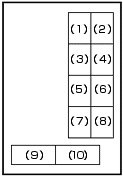
In the local language (Flores Island), "keli" means mountain and "mutu" means boiling, shortly it can be said that "Kelimutu" means the volcano crater. It is a small yet well-known volcano. What makes it different from other volcanoes is that this 1,690m volcano has three summit crater lakes of varying colors namely Wine Red, Green, and Dark Blue. The other two lakes, Tiwu Nuwa Muri Koo Fai (Lake of Young Men and Maidens) is green and Tiwu Ata Polo (Bewitched or Enchanted Lake) is red, bother are divided by a crater wall. The lake colors vary from time to time due to the active upwelling of subaqueous fumaroles at the two eastern lakes. After an earthquake in 1992 the level of the lakes dropped and changed color overnight to their current configuration of green, chocolate and black. This special characteristic of the lake water gives it nickname "The Three Colored Lake."
(2) Fuji Mountain
At 3,776m, Fuji Mountain is the highest mountain in Japan and also an active volcano whose last recorded eruption was in 1707-1708. The mountain straddles the boundary of Shizuoka and Yamanashi prefectures just west of Tokyo. Its symmetrical cone is a well-known symbol of Japan and it is a frequent subject of Japanese art. The summit has been thought of as sacred since ancient times. Today, it is a popular tourist destination and common destination for mountain-climbing. On the stamp, it is depicted with Sakura (Cherry blossoms), another symbol of Japan, on the foreground, makes it picture-perfect. Due to its height, the climate on the summit is very cold and for a couple of months of the year, the cone is covered by snow. On a clear day, the mountain can be seen from Tokyo, Yokohama, and sometimes even as far as Chiba.
(3) Borobudur Temple
Borobudur, located in central Java, is the largest and the most glorious Buddhist monument in the world. No wonder if this temple is acknowledged as a UNESCO World Heritage Site. The 42m high structure (forming a lotus, the sacred flower of Buddha) was built on a bedrock hill in the form of three tiers: six square platforms, the trunk of a cone with three circular platforms and, at the center top, a monumental stupa surrounded by 72 Buddha statues seated inside perforated stupa. The monument is decorated with 2,672 relief panels and 504 Buddha statues. The length of each lowest part is 113 meters. It is of uncertain age, but thought to have been built between the 8th and 9th century during the ruling of Syailendra Dynasty. Following the decline of Buddhist and Hindu kingdoms in Java in the 14th century, the temple was abandoned and buried for centuries and was rediscovered in 1814 by Sir Thomas Raffles, the British ruler of Java. Borobudur has since been preserved through several restorations.
(4) Pagoda of Toji
Pagoda of Toji (Eastern Temple) is located in North Western Kyoto, often called as the Five-Story Pagoda of Toji, which refers to its architecture. The temple is most eye-catching, most important and best-known building in Kyoto. Toji (Kyo-o-Gokoku-Ji or Nation Protector) was built in 796, two years after Kammu emperor removed the empire capital city from Nara to Kyoto. Since 1994 UNESCO designated Toji a World Heritage Site. The five-story pagoda, with 57m high is the highest wooden tower in Japan. Fires and wars during the 16th century destroyed most of the temple buildings. It was reconstructed in 1634 and 1695 after burned down five times.
(5) Corpse Flower (Rafflesia arnoldii)
This plant was first discovered on 20 May 1818 by Sir Thomas Stamford Raffles who was also a naturalist and Dr. Joseph Arnold at the bank of Manna River, Lubuktapi Bengkulu. This parasitic plant was named after its two discoverers. It naturally grows in the rain forests of Sumatra and Kalimantan. This plant has no visible roots, stems or leaves. It blooms as a single fleshy flower which is the only part of the plant that appears above the ground. This magnificently colorful flower is both strange and baffling. The gigantic flower is the amazing thing about this plant. The flower is approximately one meter, weighs up to 7kg with the thickness of 2.5cm. it takes about six to eight months for the flower to fully bloom. It is the largest flower in the world according to the Guiness Book of Records. The flower appearance is very adorable, but the smell is putrid. That is the way to attract a large group of carrion flies that pollinate the plant. The putrid smell also makes it commonly referred to as the "corpse flower". (Note: The common name "corpse flower" also refers to the Titan Arum (Amorphophallus titanium) from Araceae family.
(6) Sakura (Cherry Blossoms)
Despite being a symbol of Japan, Cherry Blossoms or Sakura (Prunus serrulata) with its wide variety (Yoshino Cherry being the most well-known) actually grows in a wider area. It is indigenous to the Himalayas, including northern India, and several Eastern Asia regions such as China and Korea. The blossoming time of Sakura has become a special moment for Japanese. They pay close attention to the forecasts and turn out in large numbers at parks, shrines, and temples with friends and family to hold flower-viewing parties (this activity is called Hanami). It is the time when the imperial households, poets, singers, other aristocrats and people from every walk of life would gather and celebrate under the blossoms. The custom of hanami dates back many centuries before in China, where the object was plum tree; by the middle of the ninth century, Sakura had replaced the plum as the favored species in Japan. The blossoming time is not same in all places. In southern region like Okinawa it begins in January and reaches Kyoto and Tokyo at the end of March. It proceeds northward and arrives in Hokkaido a few weeks later.
(7) Angklung
Angklung is popular throughout Southeast Asia, but originated from Indonesia (used and played by the Sundanese in West Java since the ancient times). This traditional musical instrument is made out of bamboo tubes attached loosely to a bamboo frame. The tubes are carved and formed into different sizes so that they have different resonant pitch when struck. The bamboo tubes are formed upright towards its base, the upper parts are tied up on a rattan or small bamboo stick. To play this instrument, the player holds the base tightly with the left hand and shakes it rapidly with the right hand. This causes a rapidly repeating note to sound. Every frame of Angklung usually consists of 3 or 4 bamboo tubes, each of them produces different musical note. When it is shaken, Angklung will produce fast repeatedly sound. In an ensemble a player only plays one note, and since there are many players, together they will produce complete melodies.
(8) GakuBiwa
GakuBiwa is a four-string musical instrument used in traditional musical repertory, Gagaku. It is said that this instrument originated from Persia, crossed the Asian continent, through China and entered Japan with the introduction of Gagaku. In the Middle Ages Biwa was played solo by the Buddhist priests to tell stories and give advices. But this solo repertory has vanished, leaving only legends behind. The upper part of the body is made from rosewood, mulberry or zelkova and the surface is made of chestnut wood. The pegs for the strings are low and small, which distinguishes the gaku biwa from more modern types of biwa like the Satsuma and the Chikuaen biwa. The plectrum is made of boxwood and is thin and around 20cm long. The four strings of Gaku-Biwa are made of silk.
(9) Red Arowana (Selerophages formosus)
The name "Arwana" is derived from "Nirwana" (literally means heaven), becomes Arowana in English, and also known as aruanas or arawanas. Other nicknames are bonytongue fish, dragon fish, especially due to its large scales and barbells. For many people, Arowana is the most beautiful freshwater fish. For the Chinese and those of related cultures, the dragon is a symbol of good luck and prosperity. The fish lives in swamps and in slow-current streams. Young individuals feed on insects at the water surface, adults prey on other fishes; it is said that they can jump to prey low flying bats and small birds. Arowanas are also used for feng shui to bring good luck and wealth. The fish population gives both good or bad effects towards its status as the species that is almost extinct. Arowana has pretty big size (it can grow around 75cm), hardy and has long life period (for about 20 years). There are many Arowana species classified based on the colors of the scales, namely Green, Silver, Red tail, Yellow tail, and Golden back. Its habitat is wide; the Red Arowana depicted on the stamp, however, is known only from the upper part of the Kapuas River in western Kalimantan, Indonesia.
(10) Colored Carp Fish (Cyprinus carpio)
This colorful and beautiful member of the carp family is called Koi or nishikigoi in Japanese (simply means "crap") and can easily be found in the pond at Japanese gardens. The beauty of the fish is appraised by their most important feature, the markings and patterns. In Japan, koi breeding has occupied a position between hobby and art form for more than two centuries. The ornamental cultivation of Koi started in 17th century in the Niigata prefecture. In the beginning of 19th century they became more popular and several color patterns had been formed, most notably red-and-white. The outside world became aware of its development in 1914, when Niigata Koi were exhibited in Tokyo and some were presented to then Crown Prince Hirohito. Since then, the interest in Koi spread throughout Jpan and then worldwide. Koi varieties are distinguished by coloration, patterning, and scalation. Generally Koi have one to three different colors. Some of the major colors that often emerge are White, Yellow, Orange, Red, Black, and Blue. Spots patterns are various; however, the most sought-after patterns are round on forehead and stepping stone on its low back.
Comment: This is a Joint Issue, but Indonesia Post and Japan Post did issue this set on same date. I don't know whether this is the first time in Joint Issue history. But I'm sure It had happened and will happen in China. China - India Joint Issue (India delays); China - Great Britain (China delays).
1 Comments
Label:
Japan,
Joint Issue
Tuesday, July 1, 2008
Japan Brazil Year FDC
 Japan FDC
Name: Japan-Brazil Friendship Year
Date of Issue: 18 June 2008
The first Japanese immigrants arrived in Brazil 100 years ago. Nowadays, Brazil is home to the largest Japanese population outside of Japan, numbering an estimate of more than 1.5 million (including those of mixed-race or mixed-ethnicity).
The end of feudalism in Japan generated great poverty in the rural population, so many Japanese began to emigrate in search of better living conditions. In 1907, the Brazilian and the Japanese governments signed a treaty permitting Japanese migration to Brazil. The first Japanese immigrants (791 people - mostly farmers) came to Brazil in 1908 on the Kasato Maru from the Japanese port of Kobe, moving to Brazil in search of better living conditions. Many of them became laborers on coffee plantations. More...
Designs: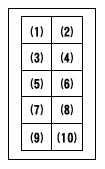
(1) Visa stamp in 1908 and coffee bean
(2) Coffee cherries and Kasato Maru (笠戸丸)
(3) The statue of Christ the Redeemer
(4) Rio de Janeiro
(5) Iguazu Falls
(6) Iguazu Falls
(7) Historic Centre of Salvador de Bahia
(8) Historic Centre of Salvador de Bahia
(9) Morpho
(10) Toco Toucan (Ramphastos toco)
Comment: Brazil Post (Empresa Brasileira de Correios e Telégrafos) issued the same theme set on same day, but their designs are quite difference besides the logo of Japan-Brazil Friendship Year.
1 Comments
Label:
Japan
Sunday, June 8, 2008
Japan Africa Prize FDC
 Japan FDC
Name: The First Noguchi Hideyo Africa Prize
Date of Issue: 23 May 2008
"Hideyo Noguchi Africa Prize" was established to commemorate the 80th anniversary of the death of Noguchi Hideyo, the worldwide known bacteriologist. The prize is aimed to award people who made outstanding contributions to medical research and medical services in Africa.
Designs:
80: Portrait of Noguchi Hideyo
80: Map of Africa and microscope
Comment: Aha, It would be great if two special cancellations had traded their position.
0
Comments
Label:
Japan
Thursday, May 22, 2008
Japan Hometowns FDC
 Jap
Jap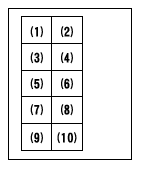 an FDC
Name: Hometowns – Scenes in My Heart
Date of Issue: 02 May 2008
Designs:
(1) Yamamoto District, Akita Prefecture 秋田県山本郡
(2) Kawagoe City, Saitama Prefecture 埼玉県川越市
(3) Gujō City, Gifu Prefecture 岐阜県郡上市
(4) Chōshi City, Chiba Prefecture 千葉県銚子市
(5) Shōzu District, Kagawa Prefecture 香川県小豆郡
(6) Gamō District, Shiga Prefecture 滋賀県蒲生郡
(7) Matsumoto City, Nagano Prefecture 長野県松本市
(8) Ise City, Mie Prefecture 三重県伊勢市
(9) Aki City, Kōchi Prefecture 高知県安芸市
(10) Hakusan City, Ishikawa Prefecture 石川県白山市
Comment: Japan Post always issues series stamps, this is the new series.
0
Comments
Label:
Japan
Friday, May 2, 2008
Japan Philately Week FDC
 Japan FDC
Name: Philately Week
Date of Issue: 18 April 2008
Comment: "Philately Week" is a regular series in every year. Japan Post always uses traditional painting for this series, and it is always depicts an animal which is the main role animal of China Lunar Zodiac in this year. Obviously, you could find a rat on this set.
0
Comments
Label:
Japan
Tuesday, April 8, 2008
Japan Astronomical FDC
 Japan FDC
Name: 100th Anniversary of the Founding of the Astronomical Society of Japan
Date of Issue: 21 March 2008
Comment: I admit this is a very beautiful issue for mint stamp collectors. For me, a real posted FDC collector, the design is not good enough for cancellation.
1 Comments
Label:
Japan
Thursday, March 13, 2008
Japan Cartoon FDC
 Japan FDC
Name: Animation Hero and Heroine Series VII "Manga Japanese Fairy Tales (Manga Nihon Mukashi Banashi)"
Issue date: 22 February 2008
This is a collection of short episodes based on Japanese Folk Tales, the series was originally broadcast on MBS in 1975 and on TBS from 1976 to 1994 and reached a peak audience rating of 33.6% in Tokyo. During that time over 2800 episodes (1400 half hour episodes with two short tales each) were created.
TBS had received many requests to re-air the series from adults who grew up watching the it present the old folk tales like Momotaro (Peach Boy) and The Monkey and the Crab.
2007 Japan Animation Hero and Heroine Series VI FDC
2008 Japan Animation Hero and Heroine Series VII FDC
0
Comments
Label:
Japan
Friday, February 15, 2008
Japan Year of Rat FDC
 Japan Lottery Souvenir Sheet FDC
Name: New Year's Stamp
Issue date: 28 January 2008
This Souvenir Sheet is the prize of Japan New Year's Lottery Stamps which was issued in end of 2007. The quantity issued was 100,000, a rare quantity for Japanese Stamps.
2008 China Year of the Rat Stamp Minisheet Booklet
2008 Hong Kong Year of the Rat FDC Minisheet FDC Imperf. S/S FDC
2008 Indonesia Year of the Rat FDC S/S FDC
2008 Japan Year of the Rat Lottery S/S FDC
2008 Singapore Year of the Rat FDC Minisheet FDC
2008 Taiwan Year of the Rat FDCs Pre-stamped Postcards
2008 Thailand Year of the Rat FDC Minisheet FDC
2008 USA Year of the Rat FDC
2008 Vietnam Year of the Rat FDC
1 Comments
Label:
Japan
Tuesday, February 5, 2008
Japan Fuji Mountian FDC
 Japan FDC
 Name: Yokoso! Japan Weeks
Issue date: 2008 January 23rd
The stamps depict Fiji Mountain's four seasons and various plants on it.
This issue is part of Yokoso! Japan Weeks, a government campaign to promote tourism in Japan and increase the number of foreign tourists which from Jan. 20 to Feb. 29, 2008.
Official Website of Yokoso! Japan Weeks
0
Comments
Label:
Japan
Friday, December 7, 2007
Japan Sexagenary Cycle FDC
 Japan FDC
Name: Chinese Zodiac Characters Greeting (Chinese Sexagenary Cycle)
Issue date: 2007 December 3rd
The Chinese sexagenary cycle (Chinese: 干支; pinyin: gānzhī) is a cyclic numeral system of 60 combinations of the two basic cycles, the ten Heavenly Stems (天干; tiāngān) and the twelve Earthly Branches (地支; dìzhī). These have been traditionally used as a means of numbering days and years, not only in China but also in other East Asian nations like Japan, Korea, and Vietnam. It is also an important part of Chinese astrology. More...
0
Comments
Label:
Japan
Monday, December 3, 2007
Japan Greetings FDCs

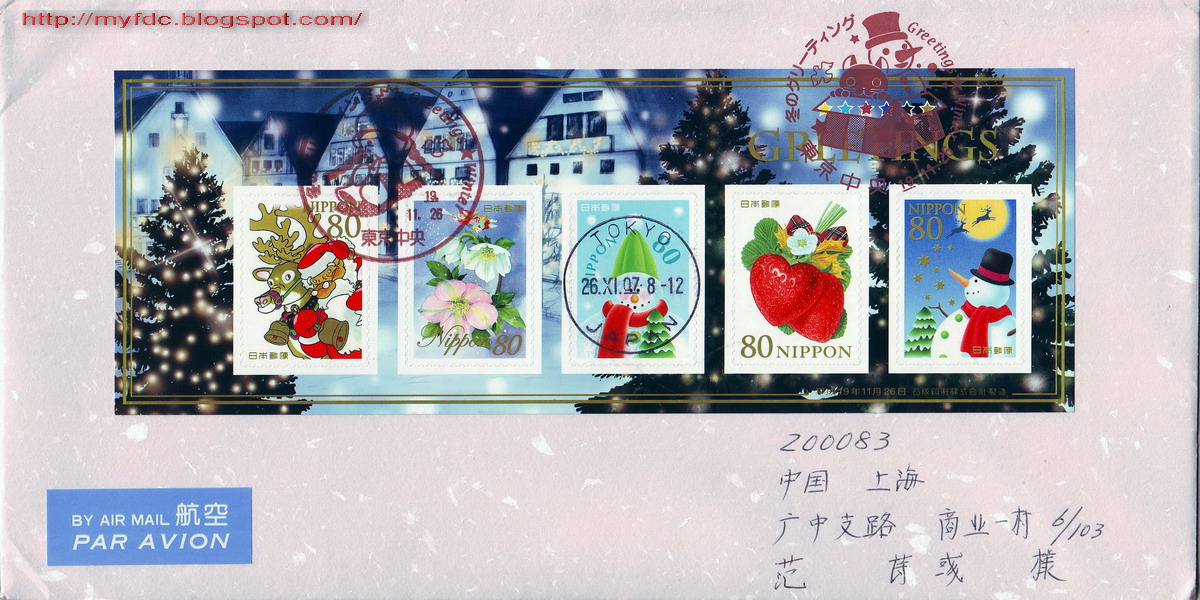
Japan FDCs
Name: Greetings - Winter (Christmas)
Date of Issue: 2007 November 26th
2009 Christmas FDCs:
Estonia, Israel, Lithuania.
2008 Christmas FDCs:
Canada: The Nativity, Canada: Winter Fun, Estonia, Italy, Lithuania.
2007 Christmas FDCs:
Estonia, Finland, Hong Kong, Japan, Lithuania, Ukraine, Vatican.
0
Comments
Label:
Japan
Friday, November 9, 2007
Japan Nagoya Port FDC
 Japan FDC
Name: The Port of Nagoya
Issue date: 2007 November 5th
The Port of Nagoya (名古屋港; Nagoya-kō) is situated at the innermost part of Ise Bay, which is located at the center of the Japanese Archipelago on the east coast facing the Pacific Ocean, the Port of Nagoya has steadily grown since it opened for international trade on November 10, 1907. The Port is an integrated international port, handling all types of cargo (general, container, bulk etc.) We are the largest port in Japan in terms of total cargo throughput, which reached 187 million tons in 2005, and counted as one of the five major ports in Japan (Ports of Tokyo, Yokohama, Nagoya, Osaka and Kobe.)
The Port of Nagoya tops all others in Japan in terms of trade value (total export/import value) in Japan, which amounted to 12.3 trillion yen in 2005. This is approximately 10% of the nation's total trade value of about 122.6 trillion yen. Of particular note is that the Port of Nagoya accounts for about 43% of Japan's total trade surplus of around 10 trillion yen.
The Port's hinterland is home to Japan's automobile industry. We are the No. 1 automobile exporting port in Japan, shipping approximately 1.4 million completed automobiles annually.
The Port of Nagoya plays a major role as a point of entry to Japan, through its connections with approximately 150 countries around the world.
Official Website of The Port of Nagoya
0
Comments
Label:
Japan
Friday, October 26, 2007
Japan Skills Festival FDC
 Japan FDC
Name: International Skills Festival for All, Japan 2007
Issue date: 2007 October 23rd
The 39th WorldSkills Competition (WSC) and the 7th International Abilympics (IA) to be jointly organized in Shizuoka, this November under the banner of International Skills Festival for All, Japan 2007, accredits 3,452 from 63 countries/regions which includes 836 competitors from 45 countries/regions for WSC and 425 contestants from 28 countries/regions for IA.
Especially, the 39th WorldSkills Competition will become the largest event more than ever in the number of countries/regions, competitors and also delegates of which are judges, official delegates, technical delegates, official observers, observers, team leaders and interpreters.
The confluence of both events will be the first time and an important chapter in their history. The joint opening will take place on Wednesday 14 November, followed by WSC through four days competing 48 skills categories and concurrently IA will continue for three days competing over 26 vocational skills and 6 leisure & living skills, each of which is one day competition. The event will be an enthusiastic showcase of skilled champions on the world stage.
Official Site of International Skills Festival for All
0
Comments
Label:
Japan
Monday, October 8, 2007
Japan Post Corporation FDCs

 Japan FDCs
Name: Establishment of Japan Post Corporation
Issue date: 2007 October 1st
In 1st Oct, 2007, the Japan Post public corporation was divided into four private entities — Japan Post Service Co., Japan Post Network Co., Japan Post Bank Co. and Japan Post Insurance Co. — under holding company Japan Post Holdings Co.
Japan Post Service manages the mail delivery services and Japan Post Network controls the post offices and their real estate.
At first, the government will own all of the shares of Japan Post Holdings, with the holding company owning 100 percent of each of the four companies. This means the four will still be funded by the government at first.
As early as fiscal 2010, however, Japan Post Bank and Japan Post Insurance are expected to go public. By October 2017, all shares of the two companies will be traded on the market, while the government reduces its stake in the holding company to about 33 percent.
The two remaining firms — Japan Post Service and Japan Post Network — will not be listed because of their public nature.
0
Comments
Label:
Japan
Sunday, October 7, 2007
Japan Brids FDC
 Japan FDC
Name: Birds - Definitive Stamps
Issue date: 2007 October 1st
Design:
50. Mandarin Duck (Aix galericulata)
80. Oriental Turtle-Dove (Streptopelia orientalis)
0
Comments
Label:
Japan
Subscribe to:
Posts (Atom)



 Posts
Posts


