Tuesday, December 11, 2007

Belarus Paintings FDCs

Stamps FDC
Minisheet FDC
Belarus FDCs
Name: Paintings from National Arts Museum of the Republic of Belarus
Issue date: 2007 November 28th

Designs: (from left to right)
1. Kshishtov Veselovskiy (1636), an unknown painter.
2. Grizeli Sapega(1632), an unknown painter.
3. Alexandra Marianna Veselovskaya (1640), an unknown painter.

The National Arts Museum is the biggest museum in the Republic of Belarus. The basis of the collection was created in the first decades of the 20th century. During World War II the museum was plundered by the Nazi. The fate of the collection remains one of the greatest mysteries of the twentieth century. During the post-war period, due to the enthusiasm and dedicated work of the museum's workers, it was reconstructed. In 1957, the Art Gallery was renamed and moved to the new building. In 1999, the museum received its national status.

Nowadays there are more than 25,600 exhibits. And the biggest collections of the museum are:
Collection of Modern Belarusian art (painting, sculpture, drawing, works of applied art)
National Belarusian Art (17-20th century)
Ancient Belarusian Art (paintings, icons, ceramics, porcelain, arts and crafts of Belarus)
Manuscripts and old printed books (16-19th century)
West European Art (16-20th century)
Russian Art (18-20th century)


These are excellent FDCs which were sent from Minsk GPO(MINSK - POCHTAMT on the postmark), and the National Arts Museum of the Republic of Belarus is only 2 blocks far from Minsk GPO. So these are exactly relevant post office FDCs. Map Link

Monday, December 10, 2007

Vietnam Year of Rat FDC

Vietnam FDC
Name: Year of the Rat
Issue date: 2007 December 1st
Number: 964

The traditional Tet festival plays a very important role in the Vietnamese spiritual life. To warmly welcome this occasion, on the first of December 2007, (Vietnam) Ministry of Information and Communications (MIC) issues the stampset: "Year of the Mouse(Rat)" consisting of 02 values with their denominations of 800d and 8,000d. The stamps are the images of Mouse - the symbolic sacrament of the year.

2008 China Year of the Rat Stamp Minisheet Booklet
2008 Hong Kong Year of the Rat FDC Minisheet FDC Imperf. S/S FDC
2008 Indonesia Year of the Rat FDC S/S FDC
2008 Japan Year of the Rat Lottery S/S FDC
2008 Singapore Year of the Rat FDC Minisheet FDC
2008 Taiwan Year of the Rat FDCs Pre-stamped Postcards
2008 Thailand Year of the Rat FDC Minisheet FDC
2008 USA Year of the Rat FDC
2008 Vietnam Year of the Rat FDC

Taiwan Year of Rat Postcards


Taiwan Pre-stampd Postcards
Name: Year of the Rat
Issue date: 2007 December 3rd
Values: 5 Postcards/Set

2008 China Year of the Rat Stamp Minisheet Booklet
2008 Hong Kong Year of the Rat FDC Minisheet FDC Imperf. S/S FDC
2008 Indonesia Year of the Rat FDC S/S FDC
2008 Japan Year of the Rat Lottery S/S FDC
2008 Singapore Year of the Rat FDC Minisheet FDC
2008 Taiwan Year of the Rat FDCs Pre-stamped Postcards
2008 Thailand Year of the Rat FDC Minisheet FDC
2008 USA Year of the Rat FDC
2008 Vietnam Year of the Rat FDC

Sunday, December 9, 2007

Turkey Cartoon Heroes FDC

Turkey FDC
Name: Turkish Cartoon Heroes (Keloğlan)
Issue date: 2007 November 29th

Keloğlan (The Bald Boy) is a famous folktale character. The tales portray him as a poor, uneducated but witty boy. He is a unique case and he always remains so, regardless of his age, or of the medical reason for his becoming bald at a tender age. He is usually the youngest member of his family, and one may even refer to him as the 'runt'. He is practically never taken seriously at first, because of his physical appearance and the invariably shabby clothes he is sporting. At times, the older and 'wiser' members of his own family may attempt to take advantage of him. Almost everyone that comes into contact with Keloğlan think they can swindle him. Only after the first such injustice perpetrated against Keloğlan that Keloğlan goes into action. In the end of all tribulations, Keloğlan invariably wins the 'contest' to his own satisfaction.

The Keloğlan stories have appeared in popular literature since the beginning of the 18th century. He is often represented as a kind of mirror, reflecting society's ideals and wishes. Keloglan represents the idealized figure of a new sociological development and a changing society, expressed by the way of folktales.

Saturday, December 8, 2007

Taiwan Year of Rat FDCs

Stamps FDC
Souvenir Sheet FDC
Taiwan FDCs
Name: New Year's Greeting (Issue of 2007)
Issue date: 2007 December 3rd
Number: Sp. 512

This year the Chinese lunar New Year falls on February 7, 2008. It is the wu-zih year (wu is the fifth of the Ten Celestial Stems and zih is the first of the Twelve Terrestrial Branches and signifies the year of the rat). To welcome the year of the rat, Taiwan Post is specially issuing a set of two New Year's Greeting Postage Stamps (Issue of 2007) as well as a souvenir sheet featuring Chinese zodiac rat. The two stamps will have denominations of NT$3.50 and NT$13.00. And the souvenir sheet will have a denomination of NT$12.00. The designs of the stamps and the souvenir sheet follow:

NT$3.50 Stamp: Inspired by traditional Chinese calligraphy and ink wash painting, this stamp vividly depicts the aura and posture of a rat.

NT$13.00 Stamp: This stamp features two brushed Chinese characters for wu-zih and a portrait of a rat. The design is rich with traditional Chinese cultural flavor.

NT$12.00 Souvenir Sheet: The sheet features two mice wearing wedding gowns under a bright red curtain; red lanterns hung on the left and right, each with an upside down Chinese character for spring, which symbolizes that spring has arrived; and the Chinese characters for the wu-zih year in the middle. In the background on both sides are symmetrically arranged paper-cut patterns of house shrews (known as "money" rodents in Chinese) and flowers. In Chinese, the word for "flower" is a homonym for "strikes it rich," and so these images of flowers symbolize becoming wealthy in the year of the rat. Two house shrews sitting on wheels represent money rolling in from a variety of sources. The sheet conveys New Year's festiveness and splendor with its shimmering gold and merry red color scheme.

2008 China Year of the Rat Stamp Minisheet Booklet
2008 Hong Kong Year of the Rat FDC Minisheet FDC Imperf. S/S FDC
2008 Indonesia Year of the Rat FDC S/S FDC
2008 Japan Year of the Rat Lottery S/S FDC
2008 Singapore Year of the Rat FDC Minisheet FDC
2008 Taiwan Year of the Rat FDCs Pre-stamped Postcards
2008 Thailand Year of the Rat FDC Minisheet FDC
2008 USA Year of the Rat FDC
2008 Vietnam Year of the Rat FDC

Friday, December 7, 2007

Japan Sexagenary Cycle FDC

Japan FDC
Name: Chinese Zodiac Characters Greeting (Chinese Sexagenary Cycle)

Issue date: 2007 December 3rd

The Chinese sexagenary cycle (Chinese: 干支; pinyin: gānzhī) is a cyclic numeral system of 60 combinations of the two basic cycles, the ten Heavenly Stems (天干; tiāngān) and the twelve Earthly Branches (地支; dìzhī). These have been traditionally used as a means of numbering days and years, not only in China but also in other East Asian nations like Japan, Korea, and Vietnam. It is also an important part of Chinese astrology. More...

India Renewable Energy M/S FDC

India Minisheet FDC
Name: Renewable Energy
Issue date: 2007 November 22nd

Design:
5.00: Solar Energy
5.00: Wind Energy
5.00: Small Hydropower
5.00: Biomass Energy

2007 India Renewable Energy FDC
2007 India Renewable Energy Minisheet FDC

Thursday, December 6, 2007

India Renewable Energy FDC

India FDC
Name: Renewable Energy
Issue date: 2007 November 22nd

Design:
5.00: Solar Energy
5.00: Wind Energy
5.00: Small Hydropower
5.00: Biomass Energy

Energy is a basic requirement for economic development. Every sector of economy-agriculture, industry, transport, commercial and domestic - needs inputs of energy. The economic development plans implemented since independence in India have necessarily required increasing amounts of energy. As a result, consumption of energy in all forms has been steadily rising all over the country.

This growing consumption of energy has also resulted in the country becoming increasingly dependent on fossil fuels such as coal, oil and gas. Rising prices of oil and gas and potential shortages in future lead to concerns about the security of energy supply needed to sustain our economic growth. Increased use of fossil fuel also causes environmental problems both locally and globally.

Against this background, the country urgently needs to develop a sustainable path of energy development. Promotion of energy conservation and increased use of renewable energy sources are the twin planks of sustainable energy supply.

Fortunately, India is blessed with variety of renewable energy sources, the main ones being biomass, biogas, the sun, wind and small hydropower.

The Department of Posts is happy to issue a set of four commemorative postage stamps on Renewable Energy depicting the four common applications of renewable energy i.e Solar Energy, Wind Energy, Small Hydropower and Biomass Energy.

2007 India Renewable Energy FDC
2007 India Renewable Energy Minisheet FDC

Wednesday, December 5, 2007

Portugal Cork FDC

Portugal FDC
Name: The Cork Sector
Issue date: 2007 November 28th

Cork. Gift of nature. National heritage. Ambassador of Portugal.

Cork, bark of the cork oak, is a renewable, recyclable and biodegradable product. The Quercus suber L., which Mother Nature planted essentially in southern Portugal, shapes the identity of the Alentejan landscape. Home to an infinite variety of animal and plant species, thanks to its multifunctionality, the cork oak stand prevents desertification of the south of the country - a dry region with thin top soil – by reducing soil erosion and contributing immeasurably to the local economy, not to mention its contribution to the fixation of carbon dioxide, the main cause of global warming.

Preserved by kings and governors, from the beginning of the nation to the present, the cork oak has always been protected by national legislation: the first references to cork oak and cork appeared as early as the 13th century in the charters of King Dinis, however cultivation of the cork oak stand as we know it today did not begin until the 19th century.

Rough in appearance but pleasant to the touch, cork has unique characteristics: it is light, impermeable to liquids and gases, compressible, elastic, an excellent thermal, acoustic and vibration insulator and resistant to friction. Used in a wide variety of areas, from construction to the automobile and aeronautics industries, it is best known as a wine stopper.

And if the Romans and Phoenicians used cork to seal their amphorae, it was Dom Pérignon in France who first used it systematically as a stopper for his precious nectar. But it was in Portugal that the knowledge and expertise needed to extract and transform it would be found. For historic reasons connected with port wine production, the industry established itself essentially in the north, in particular the Aveiro region, still the world centre for cork transformation and trade today.

A Portuguese ambassador, cork has carried the nation's name to the five continents and even into space. Today, Portugal is the world leader in cork production, transformation and export, placing it at the forefront of knowledge and research in the area and bestowing it with the responsibility of protecting and promoting this noble product of the Mediterranean forest.

Cork and the cork oak have inspired books, poems, songs, fashion, design and jewellery. They are part of Portuguese culture. A symbol that is now used as a base for a prestigious postage stamp, a stamp made of cork, the bark of the cork oak.

Tuesday, December 4, 2007

Taiwan Scouting FDC

Taiwan FDC
Name: Centenary of World Scouting
Date of Issue: 28 November 2007
Number: Com. 309

The Scout Movement started in 1907, so 2007 marks the 100th anniversary of world scouting. To celebrate a new century of scouting, Taiwan Post is specially issuing a "Centenary of World Scouting Commemorative Issue" stamp with a denomination of NT$12.00. The design of this stamp conforms to the spirit of the centenary of scouting, which has a focus on the concepts of promise and world peace. The stamp features a dove, which is a symbol of passion, freedom and peace. Scout rope is used to write out "100" and to encircle the emblems of the World Organization of the Scout Movement and the Scouts of R.O.C., symbolizing that Taiwan is marching forward in step with the world. The blue and green colors of the stamp convey the environmental spirit of the scouts, showing how scouts coexist with nature and conveying a new image of scouting for the new century. To add to the fun and the stamp's value as a collector's item, it will be printed in the shape of a rhombus.

2008 Malaysia Scouting FDC
2007 Argentina Scouting FDC
2007 Philippines Scouting FDC
2007 Taiwan Scouting FDC

Monday, December 3, 2007

Japan Greetings FDCs


Japan FDCs
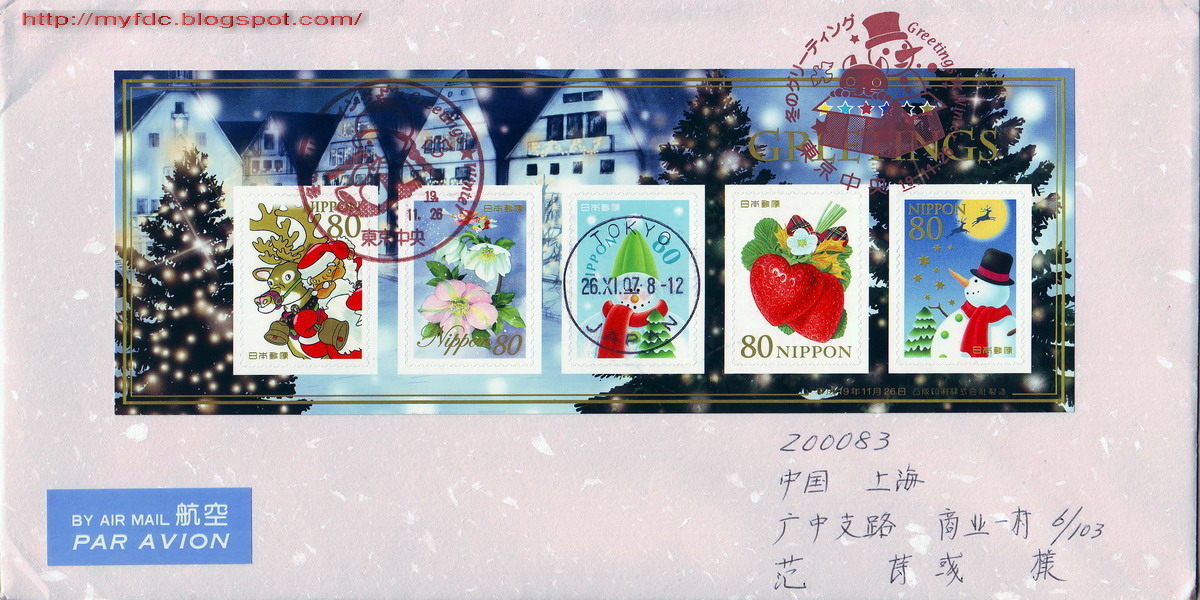
Name: Greetings - Winter (Christmas)

Date of Issue: 2007 November 26th

2009 Christmas FDCs:
Estonia, Israel, Lithuania.

2008 Christmas FDCs:
Canada: The Nativity, Canada: Winter Fun, Estonia, Italy, Lithuania.

2007 Christmas FDCs:
Estonia, Finland, Hong Kong, Japan, Lithuania, Ukraine, Vatican.

Malaysia Vegetables M/S FDC

Malaysia Minisheet FDC
Name: Rare Vegetables
Issue date: 2007 November 26th

A wide rage of rare vegetables species can be found in Malaysia. It has been estimated that about 120 species of rare vegetables or ulam that are being planted in the home gardens or still growing wild. Some of the rare vegetables are known as ulam based on the way it is being consumed such as pegaga, ulam raja or beluntas.

Rare vegetables are categorized as ulam when the fresh orboiled shoots or young fruits are eaten with sambal or budu. Ulam is the favourite appetizer in Malay cuisine. Other rare vegetables are fried or cooked with coconut milk, or made into rojak or other dishes.

Design: (from left to right)
RM1: Petola bantal (Luffa aegyptiaca)
Petola bantal is also commonly known as smooth petola due to the surface of the fruit which is smooth and slightly waxy. The plant is a climber using its tendrils. The fruit is cylindrical in shape, light green with 9-10 dark green lines along the length of the fruit. The flowers are bright yellow and the whole plant is covered with fine hair. Young fruits are normally cooked as vegetables. However, fibres from the matured fruits are used as a sponge for cleaning cooking utensils or as a loofah.

RM1: Winged bean (Psophocarpus tetragonolobus)
Winged bean is also know as kacang kelisa. The plant is type of vine growing with a climbing twining stem. Leaves are trifoliate with three leaflets. Flowers are beautiful with bluish purple in colour. Clusters consist of 2-10 flowers. Winged bean is easily recognized because it has a unique bean pod. The bean pod is about 15-22cm long, four-angled with frilly edges running lengthwise. The surface is waxy and the flesh of the young pod is partially translucent. The bean pod has a high nutritional content. Protein content is also high about 29% to 39%.

RM1: Turi (Sesbania grandiflora)
Turi or geti is a perennial plant reaching a height of 4m tall. Leaves are pinnately compound with leaflets in opposite arrangement. Flowers are white or red in colour, drooping from the flower stalk. The boiled shoot is eaten as ulam while the young leaves can be cooked with coconut milk. Petals of young flower buds can also be eaten as ulam or cooked as vegetables. In addition to that, the bark, leaf, root and flower of the plant also possess medicinal values.

RM1: Terung pipit (Solanum torvum)
Terung pipit is also known as terung rembang. The plant is weedy and can easily be found at grass fields, bushes or along roadsides. The plant is a shrub reaching a height of 1-2m tall. The leaf is large, oval in shape with triangular-lobed margin. The whole plant is covered with sharp thorns such as on the stem, leaf stalks and inflorescence axis. Flowers are white in colour and arranged in a cluster. The fruits are similar to berries, round, small in size and are borne in a short bunch. The young fruits are usually eaten as ulam either fresh or boiled. It can also be fried or cooked in dishes. The fruits are believed to reduce high blood pressure.

2007 Malaysia Rare Vegetables FDC
2007 Malaysia Rare Vegetables Minisheet FDC

Sunday, December 2, 2007

Malaysia Vegetables FDC

Malaysia FDC
Name: Rare Vegetables
Issue date: 2007 November 26th

A wide rage of rare vegetables species can be found in Malaysia. It has been estimated that about 120 species of rare vegetables or ulam that are being planted in the home gardens or still growing wild. Some of the rare vegetables are known as ulam based on the way it is being consumed such as pegaga, ulam raja or beluntas.

Rare vegetables are categorized as ulam when the fresh orboiled shoots or young fruits are eaten with sambal or budu. Ulam is the favourite appetizer in Malay cuisine. Other rare vegetables are fried or cooked with coconut milk, or made into rojak or other dishes.

Design: (from right to left)
50sen: Terung asam (Solanum ferox)
The tree is small, reaching a height of 0.5-1.0m tall. The whole plant parts are covered with fine hair. Leaves are sub-opposite in arrangement and the shape is oval with triangular lobes. The upper leaf surface is covered with thorns along the veins. The flowers sprout in racemes with short stalks. Flower petals are white and powdery. The fruits are oval in shape, 2-3 cm wide and also covered with fine hair. The fruit is initially green and turns yellow when it is ripe. Its sour taste makes it suitable to be used as a sour flavouring for dishes.

50sen: Bitter melon (Momordica charantia)
The herbaceous, tendril-bearing vine grows to 5m tall. Leaves 4-12cm wide, with 3-7 deep lobes are alternately arranged. The flowers are yellow in colour. The fruit is green, oblong, 17-23cm long, with a distinct warty surface. Young fruits possess white seeds and piths turning red upon ripening. Fruits taste bitter but the bitter taste can be reduced by soaking the fruits in salt water before cooking. The flesh is juicy and crunchy in texture. The young fruit is normally eaten as ulam. Bitter melons have been used in various Asian medicines for a long time as it is believed to possess anti-malarial properties and can control diabetes and cure skin diseases.

50sen: Torch ginger (Etlingera elatior)
The plant can reach 5m in height. The flower is pink in colour on a long stalk, about 90cm in length, arising from its rhizome in the ground. Torch ginger flower, also known as Kantan flower is popular because it is widely used as flavouring in many dishes especially in laksa and asam pedas. In addition to that, the flower has high antioxidant properties. The fruit and leaf also posses their own unique medicinal values.

2007 Malaysia Rare Vegetables FDC
2007 Malaysia Rare Vegetables Minisheet FDC

Saturday, December 1, 2007

Estonia Christmas FDCs

Christmas/391
Christmas/392
Estonia FDCs
Name: Christmas
Date of Issue: 22 November 2007

It is late, but children cannot sleep. How do you sleep when there are thousands of golden stars shining in the pitch black sky, when the mirror surface of the frozen lake creates two worlds instead of one? How can you pull the blanket over your head, if your heart would like to sing and to play, if everything outside the window looks so mysterious and inviting? Children cannot sleep. They hurry outside into snowy fields, shouting and laughing. Their hands in their mittens are not afraid of the cold that has frozen the nature all around. On the contrary, they feel particularly warm and safe. It is Christmas night. If they are lucky, they can spy a tiny angel peeping from behind a frosty spruce tree.

2009 Christmas FDCs:
Estonia, Israel, Lithuania.

2008 Christmas FDCs:
Canada: The Nativity, Canada: Winter Fun, Estonia, Italy, Lithuania.

2007 Christmas FDCs:
Estonia, Finland, Hong Kong, Japan, Lithuania, Ukraine, Vatican.

Friday, November 30, 2007

India Children's Day M/S FDC

India Minisheet FDC
Name: Children's Day
Issue date: 2007 November 14th

Children are God's greatest gifts to mankind. Their pure innocence, pristine thoughts and bubbling enthusiasm lend a unique flavour to life. The wondrous eyes of a child perceive with crystal clear honesty the myriad hues of nature and its bounties. To a child, the world is pure magic. Each day to a child unfolds a new secret, a new joy which the child rushes to embrace with outstretched arms.

Children's Day is celebrated every year on the 14th of November. This day also coincides with the birthday of India's first Prime Minister Pandit Jawaharlal Nehru fondly called ‘Chacha Nehru' by children.

The Department of Posts commemorates Children's Day every year by bringing out stamps designed by the children themselves. The stamp designs are selected by holding on All India Stamp Design Competition. The theme for the Stamp Design Competition this year was "The Magic of the Night". The competition elicited great response and the entries revealed beautifully the flight of a child's fantasy.

This year's stamps are based on painting made by Kum.Swarali.V.Bhakare, Class IV, Annasaheb Raje Bhosale, Primary School, Satara, Maharashtra and B.Karthick, Class VIII, T.E.L.C Middle School, Pudukottai, Tamil Nadu who won the first prizes in Group I and Group II respectively. Miniature sheet is based on the painting made by Master Pradhan Karnik, Class IX, Kendriya Vidyalaya, NAL Campus, Jeevan Bhimanagar, Bangalore, Karnataka which won the first prize in Group III.

The design of the First Day Cover is based on painting by Raj Ballav Hazarika, Class XII, K.V. Narangi School, Assam APS, which won the second prize in Group III of the competition.

The painting reveal the inner working of a child's mind and what magic it weaves in the phenomena of night, seeing it through its wide eyed innocence. The Department of Posts is happy to celebrate this spirit of innocence by releasing this set of two postage stamps.

2007 India Children's Day Minisheet FDC
2008 Thailand National Children's Day FDC

Related Posts with Thumbnails