 Thailand Sheetlet FDC
Name: Provincial Emblems (1st Series)
Date of Issue: 11 October 2007
Designs: from top to bottom, left to right.
1. Chaiyaphum (ชัยภูมิ)
2. Chumphon (ชุมพร)
3. Chiang Rai (เชียงราย)
4. Chiang Mai (เชียงใหม่)
5. Trang (ตรัง)
6. Trat (ตราด)
7. Tak (ตาก)
8. Nakhon Nayok (นครนายก)
9. Nakhon Pathom (นครปฐม)
10. Nakhon Phanom (นครพนม)
2007 Thailand Provincial Emblems FDCs: (1st Series)
(Part I), (Part II), (Part III), (Part IV)
2007 Thailand Provincial Emblems Sheetlet FDCs: (1st Series)
(Part I), (Part II)
2008 Thailand Provincial Emblems FDCs: (2nd Series)
(Part I), (Part II)
2008 Thailand Provincial Emblems Sheetlet FDC (2nd Series)
2008 Thailand Provincial Emblems FDCs: (3rd Series)
(Part I), (Part II)
2009 Thailand Provincial Emblems FDCs: (4th Series)
(Part I), (Part II)
Thursday, October 18, 2007
Thailand Provincial Emblems S/L FDC-2
 0
Comments
Label:
Thailand
Thailand Provincial Emblems S/L FDC-1
 Thailand Sheetlet FDC
Name: Provincial Emblems (1st Series)
Date of Issue: 11 October 2007
Designs: from top to bottom, left to right.
1. Bangkok (กรุงเทพฯ)
2. Krabi (กระบี่)
3. Kanchanaburi (กาญจนบุรี)
4. Kalasin (กาฬสินธุ์)
5. Kamphaeng Phet (กำแพงเพชร)
6. Khon Kaen (ขอนแก่น)
7. Chanthaburi (จันทบุรี)
8. Chachoengsao (ฉะเชิงเทรา)
9. Chon Buri (ชลบุรี)
10. Chai Nat (ชัยนาท)
2007 Thailand Provincial Emblems FDCs: (1st Series)
(Part I), (Part II), (Part III), (Part IV)
2007 Thailand Provincial Emblems Sheetlet FDCs: (1st Series)
(Part I), (Part II)
2008 Thailand Provincial Emblems FDCs: (2nd Series)
(Part I), (Part II)
2008 Thailand Provincial Emblems Sheetlet FDC (2nd Series)
2008 Thailand Provincial Emblems FDCs: (3rd Series)
(Part I), (Part II)
2009 Thailand Provincial Emblems FDCs: (4th Series)
(Part I), (Part II)
0
Comments
Label:
Thailand
China Stamp: 2007-30

 China Stamp
Name: Chinese Calligraphy--Kai Shu (Standard Style)
Number: 2007-30T
Issue date: 2007 November 5th
Minisheet of this set
The regular script or standard script, or in Chinese kaishu (Simplified Chinese: 楷书; Traditional Chinese: 楷書; pinyin: kǎishū) and Japanese kaisho, also commonly known as standard regular (正楷), is the newest of the Chinese calligraphy styles (maturing around the 7th century), hence most common in modern writings and publications (after the non-calligraphic printing Song Ti). It is also occasionally known as true script (真書 zhēnshū) and standard script (正書 zhèngshū).
Regular script came its current form in the 5th century during the Southern and Northern Dynasties. Script from this period is the "Wei regular" (魏楷 Weikai). Some consider the regular script to be the direct derivative of clerical script, while others believe running script also has influence in some regular script calligraphers' styles as well. More...
0
Comments
Label:
China
Wednesday, October 17, 2007
Hong Kong Christmas FDC
 Hong Kong FDC
Name: Christmas Stamps II
Date of Issue: 11 October 2007
A festival of Western origin, Christmas is celebrated in many places around the world. Hong Kong is no exception. At Christmas time the city is lit up by glittering decorations, with sweet carols floating in the air. To bring tidings of comfort and joy, Hongkong Post issued its first set of Christmas Stamps in 2002. The innovative design of its second set features a perfect fusion of elements from Western tradition and local culture.
The four stamps in this issue blend traditional Christmas icons with local elements to inspire a feeling of affinity: a stocking in red-white-and-blue nylon canvas ($1.40), an egg tart in the form of a smiling Gingerbread Man ($2.40), a bell-shaped sparkling neon light ($3) and a jolly Snowman dressed in a cotton-padded Chinese vest ($5).
The design of these stamps draws influence from Chinese and Western customs, with a touch of indigenous flavour, which highlights our openness to foreign culture and growing sense of local identity. The traditional icons and cheerful colours of the stamps commemorate the time-honoured spirit of this joyous festive season.
2009 Christmas FDCs:
Estonia, Israel, Lithuania.
2008 Christmas FDCs:
Canada: The Nativity, Canada: Winter Fun, Estonia, Italy, Lithuania.
2007 Christmas FDCs:
Estonia, Finland, Hong Kong, Japan, Lithuania, Ukraine, Vatican.
0
Comments
Label:
Hong Kong
Taiwan Seashells (I) FDC
 Taiwan FDC
Name: Seashells of Taiwan (1st Series)
Date of Issue: 11 October 2007
Surrounded by water and situated in the middle of the Western Pacific Island Arc, Taiwan has an excellent geographical location for supporting a wide variety of marine life. The north coast of Taiwan proper is rocky; the east coast and the Hengchun peninsula are rich with coral reefs; the west coast and the Taiwan Strait are sandy; and the offshore islands offer even more complex ecologies. What's more, because the Kuroshio Current passes by, a great number of seashells are found hereabouts.
Designs:
1. Marchia loebbeckei (NT$5.00): These unusual looking shells are diamond-shaped or semi-triangular, with banana-leaf-shaped protrusions from their axial ribs. Most of these shells are pink or orange, while a few are bright red. The shells are thin and fragile. Consequently, there are few perfect specimens. Their apertures are round and siphonal canals often forked. Marchia loebbeckei are found on the pebble seabed 100 to 200 meters deep and are occasionally seen in the waters around northern Taiwan.
2. Harpa major (NT$5.00): Shaped like pears or fists, and reddish brown in color, these shells feature intricate patterns. With low spires and well-defined axial ribs on their body whorls, they look like harps. For this reason, they are called major harps in the west. Harpa major dwell in shallow water on sand no deeper than 30 meters.
3. Epitonium scalare (NT$12.00): Known as precious wentletraps in English, these beautiful shells are white and lustrous with rounded whorls, very deep sutures and prominent axial varices that run across all of the whorls. Their apertures are nearly round with thick lips. Epitonium scalare live in shallow water on sand and are often found in the continental slope of the Taiwan Strait.
4. Cypraea aurantium (NT$12.00): Known as golden cowries in English, these are large egg-shaped shells with shiny and reddish orange dorsums and white bases and extremities. Their narrow, long, slit-like apertures have orange teeth. Golden cowries used to be considered rare, but then it was discovered that they live in well-hidden caves in coral reefs and are just hard to spot.
2007 Seashells of Taiwan FDC (1st Series)
2008 Seashells of Taiwan FDC (2nd Series)
2009 Seashells of Taiwan FDC (3rd Series)
0
Comments
Label:
Taiwan
Tuesday, October 16, 2007
Thailand Letter Writing Week M/S FDC
 Thailand Minisheet FDC
Name: International Letter Writing Week 2007
Date of Issue: 08 October 2007
More detail of this issue...
2008 Thailand International Letter Writing Week FDC
2007 Thailand International Letter Writing Week FDC
2007 Thailand International Letter Writing Week Minisheet FDC
0
Comments
Label:
Thailand
Monday, October 15, 2007
Thailand Letter Writing Week FDC
 Thailand FDC
Name: International Letter Writing Week 2007
Date of Issue: 08 October 2007
Purpose:
To commemorate the 2007 International Letter Writing Week during 8-14 October 2007.
Design:
Illustrate the paintings which won first prizes in the 2007 International Letter Writing Week postage stamp painting competition, under the theme "Traditional household gadgets".
1. (Red): Betel nut scissors, Designed by Mr. Poraphon Khomprapha
2. (Yellow): Betel nut masher, Designed by Mr. Chanya Boonyasakdi
3. (Purple): Cylinder-and-piston igniter, Designed by Mr. Chanya Boonyasakdi
4. (Green): Earthenware oil-lamp/incense dish, Designed by Mr. Chanya Boonyasakdi
2008 Thailand International Letter Writing Week FDC
2007 Thailand International Letter Writing Week FDC
2007 Thailand International Letter Writing Week Minisheet FDC
0
Comments
Label:
Thailand
Kazakhstan Gali Ormanov FDC
 Kazakhstan FDC
Name: 100th Anniversary of the poet Gali Ormanov
Issue date: 2007 September 28th
It's exactly one hundred years since the famous Kazakh poet Gali Ormanov was born. The author of many wonderful lyrical collections of poems is also remembered as a brilliant translator. Gali Ormanov's centenary was celebrated in his homeland, in the Almaty region. At the beginning of his career he was often compared with his spiritual mentors such as Ilyas Zhansugurov and Zhambyl Zhabayev. In his own poems, however, Ormanov would always say that he didn't resemble any other poet. The author of "Abysyn Syry", "Oi Kanaty", and "Syat Sapary"found his niche among the classicists of Kazakh poetry.
Kazhytai Ilyasov, editor of G. Ormanov's complete works: "His poems do not have soft music characteristic of poetry; but even if it has, this music is insignificant. Thought was paramount for Gali. At the same time, he is a very lyrical poet. A phrase from the foreword of Gabit Musrepov's 4-volume book about Ormanov has embedded in my memory: it reads: "If the social processes could be viewed as an apple, Gali Ormanov studied not only the apple itself, but the apple-tree, its roots and the way it is watered."
Gali Ormanov translated Mayakovsky, Maupassant and Sholokhov into Kazakh and the pinnacle of his career success was the translation of Tolstoi's "Anna Karenina". A folk-lore museum in Taldykorgan has preserved his personal belongings, manuscripts and photographs of the poet with Sabit Mukanov, Tair Zharokov and Gabit Musrepov. This photo shows Ormanov as a literary secretary of the great akyn Zhambyl standing beside Dina Nurpeisova and Zhambyl. Behind the glass-case there are his personal electric razor "Kharkov-22", his favourite skull-cap and an ash-tray which Balkhash metal-workers gave to him as a present. All of these items are already history, but the poet's disciples say Gali Ormanov will live in their hearts as long as people need poetry.
1 Comments
Label:
Kazakhstan
Sunday, October 14, 2007
India S. D. Burman FDC

 India FDC
Name: S. D. Burman
Issue date: 2007 October 1st
Sachin Dev Burman (October 1, 1906 - October 31, 1975) (aka Burman da, also credited as Kumar Sachindra Dev Barman or S. D. Burman) was one of the most famous Bollywood music composers and an all-time great Bengali singer and composer. His son Rahul Dev Burman also achieved great success as a Bollywood music director in his own right. More...
1 Comments
Label:
India
Saturday, October 13, 2007
China Stamp: 2007-29


 China Stamp
Name: The 17th National Congress of the Communist Party of China
Number: 2007-29J
Issue date: 2007 October 15th
Design:
2-1: The Site of the First National Congress of the CPC
2-2: The Site of the Second Plenum of the Seventh CPC Central Committee
S/S: The 17th National Congress of the Communist Party of China
The 17th National Congress of the Communist Party of China (Simplified Chinese: 中国共产党第十七次全国代表大会; Traditional Chinese: 中國共產黨第十七次全國代表大會, Abbreviated Shiqi-da [十七大]) will be held in Beijing, China, at the Great Hall of the People from 15 October 2007 onwards.[1] The Congress will oversee major membership changes in leading party organs, including the Politburo Standing Committee of the Communist Party of China, and thus determine the top leadership of the People's Republic of China until 2012. Expected leadership changes include elevation of junior members that will form the "fifth generation (2012-2022)" of Chinese leaders to the Politburo, many of whom will likely be loyal to President Hu Jintao, along with the retirement of older Shanghai clique Politburo members. In addition, Hu's idea of the Scientific Development Concept to create a "Harmonious Society" will likely become one of the party's mainstream guiding ideologies. More...
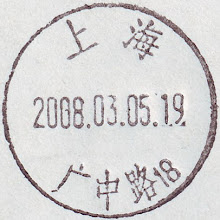
 Those FDCs were sent to my Lithuania friend on issue day by registered mail. There are 2 special cancellation on the FDC, top one is China special cancellation, bottom one is Shanghai special cancellation.
0
Comments
Label:
China
Lithuania Post History FDC
 Lithuania FDC
Name: From The Post History
Issue date: 2007 October 6th
On January 1, 1992, the State Enterprise Lithuania Post was established. It consisted of 51 branch: 47 urban and regional post offices, Mail Transportation Centre, Governmental and Special Mail Centre, Postal Vehicle Centre and Publishing Centre "Pašto ženklas". The enterprise was trusted to provide postal services, deliver pension payments, issue postage stamps, accept subscriptions for publications, deliver the ordered press, carry and deliver various postal parcels, exchange postal parcels with foreign countries. At that time the enterprise operated 1071 post office in Lithuania and had 11777 employees. On the 10th of January of the same year Lithuania restored its membership with the Universal Postal Union.
0
Comments
Label:
Lithuania
Thursday, October 11, 2007
Ukraine First Space Satellite FDC
 Ukraine FDC
Name: 50 Years of First Space Satellite Launch
Issue date: 2007 October 4th
Design:
"Sputnik 1" Artificial Satellite
The S/S selvages bear the image of satellite creator, designer of spacecrafts Serhii Korolyov(left) and designer of rocket engine Valentyn Hlushko(right).
Sputnik 1 (Russian: "Спутник-1", "Satellite-1", or literally "Co-traveler-1" byname ПС-1 (PS-1, i.e. "Простейший Спутник-1", or Elementary Satellite-1)) was the first artificial satellite to be put into geocentric orbit. Launched by the Soviet Union on October 4, 1957, it was the first satellite of the Sputnik program.
The satellite helped to identify the density of high atmospheric layers by its orbit change and provided data on radio-signal distribution in the ionosphere. Because the satellite's body was filled with pressurized nitrogen, Sputnik 1 also provided the first opportunity for meteorite detection, as losses in internal pressure due to meteoroid penetration of the outer surface would have been evident in the temperature data. The unanticipated announcement of Sputnik 1's success precipitated the Sputnik crisis in the United States and ignited the so-called Space Race within the Cold War.
Sputnik-1 was set in motion during the International Geophysical Year from the Site No.1 at the 5th Tyuratam range in Kazakh SSR (now at the Baikonur Cosmodrome). The satellite travelled at 29,000 kilometers (18,000 mi) per hour and emitted radio signals at around 20.005 and 40.002 MHz which were monitored by amateur radio operators throughout the world. The signals continued for 22 days until the transmitter batteries ran out on October 26, 1957. Sputnik 1 burned as it fell from orbit upon reentering Earth's atmosphere, after traveling about 60 million km (37 million miles) and spending 6 months in orbit. More...
0
Comments
Label:
Ukraine
Russia Fauna WWF M/S FDC
 Russia Minisheet FDC
Name: Fauna - WWF
Issue date: 2007 October 1st
More Detail of This Set..
0
Comments
Label:
Russia,
WWF
Wednesday, October 10, 2007
Russia Fauna WWF FDC
 Russia FDC
Name: Fauna - WWF
Issue date: 2007 October 1st
Design:
5.00: Oriental White Stork (Ciconia boyciana)
The Oriental Stork, Ciconia boyciana is a large, white bird with black wing feathers. It is closely related and resembles the European White Stork, of which it was formerly often treated as a subspecies. It is larger than the White Stork, at 1.29 m (4.2 ft) long, a weight of 4.4 kg (9.6 lbs) and a wingspan of 2.22 m (7.3 ft). Unlike its more widespread cousin, the Oriental Stork has red skin around its eye, with a whitish iris and black bill. Both sexes are similar. The female is slightly smaller than male. The young are white with orange bills.
At one time, the Oriental Stork could be found in Japan, China, Korea and Russia. It is now extinct in Japan and South Korea. However, in May 2007 a hatchling was reported in Japan for the first time in 40 years in the wild. It was offspring of two storks who were bred in captivity. After breeding, the storks migrate to eastern China in September and return in March. More...
6.00: Snow Leopard (Uncia uncia)
The Snow Leopard (Panthera uncia or Uncia uncia, sometimes known as the Ounce, is a large cat native to the mountain ranges of central and southern Asia. The taxonomic position of this species has been subject to change. In the past, many taxonomists included the Snow Leopard in the genus Panthera, with several of the other largest felids, but later it was placed in its own genus, Uncia. However, most recent molecular studies place the species firmly within the genus Panthera, although the exact position remains unclear. Along with the Clouded Leopard, it represents an intermediate between so-called big cats and smaller species, as it cannot roar, despite possessing a cartilaginous hyoid apparatus which is thought essential in allowing the big cats to roar.
Well known for its beautiful fur, the Snow Leopard has a soft grey coat with ringed spots and rosettes of black on brown. The fur turns white in the winter. Its tail is heavy with fur and the bottom of its paws are covered with fur for protection against snow and cold. The life span of a Snow Leopard is normally 15-18 years, but in captivity they can live up to 20 years. More...
7.00: Wisent (Bison bonasus)
The Wisent or European Bison (Bison bonasus) (IPA: [ˈviːzənt]) is a bison species and the heaviest land animal in Europe. A typical wisent is about 2.9 m (9.5 ft) long and 1.8–2 m (5.9–6.5 ft) tall, and weighs 300–920 kg (660–2000 lb). It is typically smaller than the related American bison (B. bison), and has shorter hair on the neck, head, and forequarters, but longer tail and horns. Wisents are forest-dwelling. They have few predators with only scattered reports from the 1800s of wolf and bear predation (besides humans). Wisents were first scientifically described by Carolus Linnaeus in 1758. Some later descriptions treat the wisent as conspecific with the American bison. It is not to be confused with the aurochs.
The species is now endangered. In the past they were commonly killed to produce hides and drinking horns, especially during the Middle Ages. More...
0
Comments
Label:
Russia,
WWF
China Pre-stamped Postcard HP2008
 China Pre-stamped Postcard
Name: Happy New Year (Year of the Rat)
Number: HP2008
Issue date: 2007 October 9st
Values in Set: 4
Being the first sign of the Chinese zodiac, rats are leaders, pioneers and conquerors. They are charming, passionate, charismatic, practical and hardworking. Rat people are endowed with great leadership skills and are perhaps the most organized and systematic of the twelve signs. Intelligent and cunning at the same time, rats are highly ambitious and strong-willed people who are keen and unapologetic promoters of their own agendas, which often include money and power. They are energetic and versatile and can usually find their way around obstacles, and adapt to various environments easily. A rat's natural charm and sharp demeanor make it an appealing friend for almost anyone, but rats are usually highly exclusive and selective when choosing friends and so often have only a few very close friends whom they trust. More...


0
Comments
Label:
China



 Posts


