Monday, July 9, 2007

Thailand National Park FDC

Thailand FDC
Name: Pa Hin Ngam National Park
Issue date: 2007 July 2nd
Pa Hin Ngam National Park stamps collection is printed with special technique, leaving a natural stone touch on it's surface.

1. Elephant - shaped rock
2. Radar - shaped rock
3. Hen - shaped rock
4. Football World Cup - shaped rock

Sunday, July 8, 2007

Republic of Korea Goguryeo FDC

Republic of Korea FDC
Name: Goguryeo Series (3rd)
Issue date: 2007 July 2nd

What was daily life like in Goguryeo? Around the mid 5th century, Goguryeo occupied the largest territory in Korea’s history. The initial mural paintings in ancient tombs, drawn around this period, described the details of daily lives and customs, in the hope that an abundant life in this world will be renewed in the afterlife. The last segment of the Goguryeo series re-introduces the life of the people of Goguryeo seen through the murals in ancient Goguryeo tombs.

Goguryeo people, both men and women, wore the jeogori (jacket) and baji (trousers), with women usually wearing a chima (skirt) on top of the baji. A cloth of different color was attached to the parts of clothing that could get easily dirty and worn-out, such as the edge of the outerwear sleeve or the chima’s hem. This attached cloth also served a decorative purpose. As for their diet, they ground grains such as millet, bean, wheat, barley, African millet, Chinese millet and steamed them in an earthenware steamer. They raised cows, pigs, chickens and dogs, while hunting mountain pigs, roe deer, pheasants, etc. Maekjok, thought to be a Goguryeo meat dish, is the predecessor of today’s bulgogi. Also shown in the tomb murals are various architectural styles. A nobleman’s mansion was composed of sarangchae (men’s quarters) and anchae (women’s quarters). Around the anchae were a kitchen, butcher’s area, rice mill, stable, horse barn, carriage shed, etc. with a garden cultivated on the corner of the wide yard. A commoner’s house had a simple, one or two room structure, as shown by the ruins of house sites. In addition, the murals indicate that the Goguryeo people enjoyed archery, hunting and various arts such as dancing and playing musical instruments.

The new stamps feature the kitchen of the Anak Tomb No. 3 murals (South Hwanghae Province, North Korea) and the part of Muyongchong (Muyong Tomb, Jian, China) murals that describes a host welcoming his guest. The selvage of the stamp sheet features: the part of Deokheung-ri Mural Tomb (Nampo, N\orth Korea) that depicts a noblewoman going out on a visit; several parts of the Muyongchong murals that depict dancers, servants carrying small dining tables and people playing horns; the part of Susan-ri Mural Tomb (Nampo, North Korea) that describes people performing acrobatics; and a Saiho (four-eared pot), Goguryeo’s representative earthenware.

Saturday, July 7, 2007

Ukraine Shukhevych FDC

Ukraine FDC
Name: 100th Birth Anniversary of Roman Shukhevych (1907-1950)
Issue date: 2007 June 29th

Roman Shukhevych (also known by his pseudonym Taras Chuprynka) (b. June 30, 1907 — d. March 5, 1950) was a Ukrainian politician and military leader, the leader of the Ukrainian Insurgent Army.

In 1939 Shukhevych headed the Ukrainian group Nachtigall, the battalion of Wehrmacht, manned by Ukrainians.

In October, 1941 Shukhevych became the assistant commander of the 201st battalion of the Ukrainian auxiliary police (German: Schutzmannschaft) which from March 1942 participated in anti-guerrilla operations in Belarus.

From December 1943, Shukhevych was the supreme commander of the Ukrainian Insurgent Army. In 1944 he managed to unite Ukrainian organisations in the Ukrainian Supreme Liberation Council (UHVR). He died in combat with special units of the MVD.


Friday, July 6, 2007

Japan Dance FDC

Japan FDC
Name: Owara - Kazenobon . Mai
Issue date: 2007 July 2nd

The annual festival on September 1 to 3, for three days, is supposed to be an event to offer prayers and dancing for the safety in the typhoon season and abundant harvest. People dance the night away in the streets of Yatsuo with plaintive melodies of Chinese fiddle, elegant songs and three types of dance. The stamps decipt the scenery of festival.

1. Owara - Light.

2. Owara - Lattice Door.
3. Owara - Saotome Dancers.
4. Owara - Limelight.

5. Owara - Moon.

Japan Landmarks & Flowers FDC

Japan FDC
Name: Landmarks and Flowers in Tokyo
Issue date: 2007 July 2nd

The stamps depict landmarks in Tokyo with flowers.
1. Tokyo Tower and wintersweet.
2. Double Bridge and Orychophragmus violaceus.
3. Zingu-Gaien and fragrant orange-colored olive.
4. Lake Okutama and Gentian.
5. Nihonbashi Bridge and sasanqua.

Thursday, July 5, 2007

China Leader FDC

Detail of this set

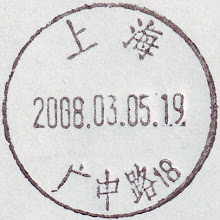
This is today's FDC I sent to my exchange partner. If you are my FDC exchange partner, you will get a FDC like this. There are two special cancellations on the FDC, left one is Shanghai special cancellation and right one is China special cancellation. Hope you like it.

If you want get China FDC like this, and exchange FDC with me, you can contact with me.
soccer.fcum@gmail.com

Japan Scenic FDC

Japan FDC
Name: Scenic Spot of Tohoku
Issue date: 2007 July 2nd

Tuesday, July 3, 2007

Republic of Korea History FDC

Republic of Korea FDC
Name: Centennial Anniversary of Special Envoy to the Hague
Issue date: 2007 June 27th

"A truly great country is not one with extensive territory nor population. Even though its territory and population may be small, a country with great people becomes a great country. A great person, for the sake of his mother country, becomes the blood of his country's life." - Patriot Lee Chun.

The Eulsa Treaty signed in 1905 under Japan's coercion put Taehan Cheguk (the Empire of Korea) into the crisis of losing its national sovereignty and diplomatic privileges. Faced with this crisis, Korean Emperor Gojong dispatched in secret a cadre of special envoys made up of Lee Sang-Sol, Lee Chun, and Lee Wi-Jong to the Second Hague Peace Conference being held in The Hague, Netherlands in June 1907. Their mission was to engage in diplomatic activities aimed at appealing to the world's great powers to invalidate the Eulsa Treaty and restore Taehan Cheguk's national sovereignty. Carrying Emperor Kojong's credentials and secret messages, the suite of special eonvoys arrived at The Hague after two months of journey via Russia. At The Hague, they sent letters to the delegation of each country attending the Conference to elicit support to allow their participation in the Peace Conference. They also strived, through open speeches and media broadcasting, to inform the international community of the wretched situation that Korea was in. After Japan's interruptions stifled their plan, Lee Chun died in a fit of anger while Lee Sang-Sol and Lee Yi-Jong toured Europe, continuing to conduct diplomatic activities aimed at recovering Korea's national sovereignty.

Monday, July 2, 2007

Argentina War FDC

Argentina FDC
Name: Bicentennial of the Defense of Buenos Aires
Issue date: 2007 June 23rd

"...No doubt, you will find that Buenos Aires is the best located spot in South America as regards commerce – it is a major centre concentrating trade from all the provinces; it is the channel through which a large proportion of Chile’s and Peru’s wealth circulates every year…”, said a letter by Home Riggs Popham, commander of the British expedition that arrived at the Rio de la Plata in 1806, that would later be called First British Invasion. The British rule then set up lasted 46 days, and would then be overthrown by the inhabitants of the city of Buenos Aires through the actions known as La Reconquista (the Reconquest). But some months later, more than 9,000 British soldiers disembarked at Ensenada de Barragan led by Sir John Whitelocke, who had received an explicit order from Your Majesty – Buenos Aires was to be subjected to British rule.

As had been planned by the commander of the invading forces, the British attacked Buenos Aires on 5th July, at dawn, thus beginning the Second British Invasion. By then, as a result of the notice issued by Liniers after the first invasion summoning the inhabitants of Buenos Aires to create an army, local forces included almost 8,000 trained men, that were stationed at different locations throughout the city. The local community acted with courage and heroism – all neighbours, including families and their slaves took part supporting the army. With not even a chance of achieving victory, Whitelocke surrendered on 7th July, and the British forces withdrew from Buenos Aires for good.

China Stamp: 2007-19

China Stamp
Name: Nanji Islands Marine Nature Reserve
Number: 2007-19T
Issue date: 2007 July 10th

Situated in the seashore area of Zhejiang Province in the middle part of western Pacific Ocean, the Nanji Islands Marine Nature Reserve, occupying a total area of 20,106 hectares including marine area of 19,071 hectares, is the first island ecosystem nature reserve in China.

The Nanji Islands consist of 23 islands, 14 submerged reefs and 55 open reefs. Among them the largest island is Nanji Island with area of 7 square kilometers and its highest mountain is Dashan Mountain with an altitude of 229 meters above sea level. According to statistics, the Reserve has 403 species of sea molluscs accounting for 20 percent of the total in China and 80 percent of the total in Zhejiang Province, 174 species of sea algaes accounting for 20 percent of the total in China, 368 species of fishes, 180 species of shrimps and crabs, 317 species of seed plants and 55 species of vertebrates.

The Reserve has not only abundant flora and fauna resources, but also the characteristics of the two systems of temperate/tropical zones, as well as the fracture distribution in territory. Therefore, the Reserve will play an important role in scientific research, production and marine ecosystem protection. More and more tourists are coming here for summer holidays.

The Nanji Islands Marine Nature Reserve has become an important base for education and scientific research and a famous scenic spot for marine ecosystem tourism in East China.

China Stamp: 2007-18

China Stamp
Name: Centenary of Birth of Yang Shangkun
Number: 2007-18J
Issue date: 2007 July 5th

Yang Shangkun (May 25, 1907–September 14, 1998) was President of the People's Republic of China from 1988 to 1993, and was permanent Vice-chair of the Central Military Commission.

Yang Shangkun information in Wikipedia

Sunday, July 1, 2007

China Hong Kong FDC

Detail of this set

This is today's FDC I sent to my exchange partner. If you are my FDC exchange partner, you will get a FDC like this. There are two special cancellations on the FDC, bottom one is Shanghai special cancellation and top one is China special cancellation. Hope you like it.

This set was very hot today, I bought all of my wanted materials from 6 different post offices.
This is a photo I took at Shanghai Philately Company around 10:00 AM. Company open at 7:30 AM, but still had many collectors queued up for today's materials.

If you want get China FDC like this, and exchange FDC with me, you can contact with me.
soccer.fcum@gmail.com

China Minisheet: 2007-17

China Minisheet (Jointly issue with Hong Kong)
Name: The 10th Anniversary of the Reunification of Hong Kong with China
Number: 2007-17J
Issue date: 2007 July 1st

There are 3 China stamps and 1 Hong Kong stamp on the minisheet.

History of Hong Kong in Wikipedia

China C-Cover: PFTN-AY-08


China Commemorative Cover

Title: International Olympic Day
Number: PFTN-AY-08
1. June 23 of 1894 saw the founding of the International Olympic Committee(IOC).
2. Pierre de Coubertin, the founder of the modern Olympic Games as well as historian and educator.
3. The ancient ruins of Olympia is located in the west of the Peloponnesos Peninsula and on the northern bank of the Alpheus River in Greece.
4. The first modern Olympic Games were held in Athens, capital of Greece, from April 6 to 15 in 1896.
5. Olympic spirit is the guideline of the Olympic Games.

If you are interested in this covers, please send email to me.
soccer.fcum@gmail.com I will offer you soon.

Thailand Mask FDCs


Thailand FDCs
Name: Phi Takhon Mask
Issue date: 2007 June 23rd

The Phi Takhon Procession is a yearly tradition held in June by the natives of Dan Sai District, Loei Province. This is a part of two other merit making ceremonies - the Boon Bung Fai ceremony and the Boon Phra Wase ceremony.

The natives in Dan Sai District dress themselves as the Phi Takhon - wearing mask made from coconut husks, and hats made from bamboo sticky-rice streamers. The masks are painted with quaint designs and faces. The important symbols are the bells tied around the cow's necks. Their important weapons are swords whose ends are made into the male phallus and used to slab women who join the procession.

Related Posts with Thumbnails