 It's a embossed stamp minisheet, you can see it in the back.
 China Minisheet
Name: Chinese Calligraphy--Kai Shu (Standard Style)
Number: 2007-30T
Issue date: 2007 November 5th
Design:
6-1: Proclamation
6-2: Zhang Menglong Stele
6-3: Inscription for Sweet Spring at Jiucheng Palace
6-4: Predace for Sacred Religion at Wild Goose Pagoda
6-5: Yan Qinli Stele
6-6: Mysterious Pagoda Steele
More detail of this set
Wednesday, November 7, 2007
China Minisheet: 2007-30
 0
Comments
Label:
China
Tuesday, November 6, 2007
China Pre-stamped Postcard JP146
 China Pre-stamped Postcard
Name: The Eighth China Arts Festival
Number: JP146
Issue date: 2007 November 5th
China Arts Festival has been held every three years, which has been a national festival and has great influence both home and abroad. The 8th China Arts Festival is mainly organized by Civilization Bureau of PRC and undertaken by Hubei Province, the festival has widely attracted the attentions of government leaders at different levels.
0
Comments
Label:
China
Monday, November 5, 2007
Russia Trucks FDC
 Russia FDC
Name: The First Native Trucks
Issue date: 2007 October 25th
Design: from left to right
1. AMO-F-15 АМО-Ф-15, 1924
Zavod Imeni Likhacheva was founded in 1916 as Avtomobilnoe Moskovskoe Obshchestvo (AMO, Russian Автомобильное Московское Общество (АМО) — Moscow Automotive Enterprise). The plans were to produce Fiat F-15 1.5 ton trucks under license. Because of the October Revolution and the subsequent Russian Civil War it took until 1 November 1924 to produce the first vehicle, the AMO-F-15.
2. GAZ-AA(MM) ГАЗ-АА(ММ), 1932
The GAZ-AA was a very important vehicle for the Soviet Army throughout World War II. This 2-axle truck was based on the Ford Model AA truck and began production in 1932. It had a four cylinder, 40 HP engine and could reach a top speed of 70 km/h on roads. This workhorse was placed into a variety of roles by the Red Army including supply hauling, troop transport, ambulance, fueling, and was also converted to mount either the 25-mm AA gun or quadruple Maxim machine gun. This truck is most famous for being the vehicle used by the Soviets to cross the frozen Lake Ladoga bringing supplies into Leningrad so that the besieged city would not fall into German hands.
3. ZiS-5V ЗИС-5В, 1942
An almost identical copy of an American Autocar Model CA, the ZiS-5 ("ZiS" standing for "Zavod Imieni Stalin") was produced from 1933 on. The truck was an instant success and evolved to the workhorse of the upcoming Great Patriotic War. Due to the lack of steel, the all-metal cab of the ZiS-5 soon received a wooden style which together with the angled front fender made up the ZiS-5V.
0
Comments
Label:
Russia
Sunday, November 4, 2007
China Stamp: 2007-25

 China Stamp
Name: Gongga Shan & Popocatépetl (China - Mexico Joint issue)
Number: 2007-25
Issue date: 2007 November 22nd
2-1: Gongga Shan:
Gongga Shan (Chinese, Traditional: 貢嘎山, Simplified: 贡嘎山, Pinyin: Gònggá shān), also known as Minya Konka, is the highest mountain in Sichuan, China. It is situated in the Daxue Shan mountain range. It is the easternmost 7000 m peak in the world and the third highest peak outside of the Himalaya/Karakoram.
The peak has large vertical relief over the deep nearby gorges.
A rope way has been constructed that can transport tourists across the glacier below the mountain to a cable car station at 5000 meter altitude. More...
2-2: Popocatépetl:
Popocatépetl (commonly referred to as El Popo or Don Goyo) is an active volcano and the second highest peak in Mexico after the Pico de Orizaba (5,636 m). Popocatépetl comes from the Nahuatl words popōca 'it smokes' and tepētl 'mountain', thus Smoking Mountain. Popocatépetl is linked to the Iztaccíhuatl volcano to the north by the high saddle known as the Paso de Cortés, and lies in the eastern half of the Trans-Mexican volcanic belt.
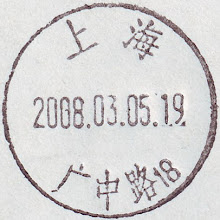
Popocatepetl is one of the most active volcanoes in Mexico, having had more than 20 major eruptions since the arrival of the Spanish in 1519. Popo is currently active. A major eruption occurred in 1947 to begin this cycle of activity. Then, on December 21, 1994 the volcano spewed gas and ash which was carried as far as 25 km away by prevailing winds. The activity prompted the evacuation of nearby towns and scientists to begin monitoring for an eruption. In December 2000, tens of thousands of people were evacuated by the government based on the warnings of scientists. The volcano then made its largest display in thousands of years. More... This FDC was sent to my Lithuania friend on issue day by registered mail. There are 2 special cancellation on the FDC, right one is China special cancellation, left one is Shanghai special cancellation.
0
Comments
Label:
China,
Joint Issue
Friday, November 2, 2007
Belarus Brids FDC

 Belarus FDC
Name: Nature of The Sanctuaries of Čepkeliai and Kotra (Lithuania - Belarus Joint Issue)
Issue date: 2007 October 3rd
Design:
Left: Great Snipe (Gallinago media)
Right: Corncrake (Crex crex)
Čepkeliai Nature Reserve, situated on the southern edge of Lithuania, consists of the biggest array of marsh in the country, overgrown continental dunes, forests and relic lakes. The River Katra marks the southern boundary of the reserve as well as the state border with Belarus. Behind it the Katra sanctuary runs in Belarus.Specific nature conditions have determined a wide variety of rare plant, insect, amphibian, reptile and bird species. Here breed the biggest populations of Great Snipes in Lithuania as well as Corncrakes, which are rare in other areas. Čepkeliai has become a safe shelter for these birds.
The Great Snipe (Gallinago media) is a very rare bird of the family Scolopacidae in Lithuania and is considered as a universally declining bird species included to the Red Data Book of Lithuania. A bird’s body reaches up to 28 cm in length; weight is 62-74 g. When flying may be recognized from white sides of the tail and 2 or 3 white strips along the wings.
The Corncrake (Crex crex) is a bird of the family Rallidae, also included to the Red Data Book of Lithuania. It lives in damp meadows and the valleys of rivers. Nests in high grass. Runs very fast and feels itself better on the ground than in the air. Flies badly and slowly. The body reaches up to 23 cm in length; weight is 130-190 g. When flying may be recognized from brown sides of the body and quite long outstretched legs.
0
Comments
Label:
Belarus,
Joint Issue
Wednesday, October 31, 2007
India Military World Games FDC
 India FDC
Name: 4th CISM Military World Games, Hyderabad 2007
Issue date: 2007 October 14th
India is privileged to host the 4th CISM Military World Games from 14 to 21 October 2007 at Hyderabad and Mumbai under the aegis of conseil International Duo Sport Militaire ('CISM' a French acronym) or International Military Sports Council, HQ based at Brussels.
CISM formed in 1948, used sports to untie the Armed forces of nations. Presently it is composed of 127 member countries which are united through its motto of 'FRIENDSHIP THROUGH SPORTS. CISM organizes over 20 World Championships annually, besides the Military Worlld Games (MWG) held every four years. The first MWG were held in 1995 in Rome, second in Zagreb Croatia 1999, and the third at Catania, Italy in 2003.
During the Afro-Asian Games in 2003 at Hyderabad, visiting CISM officials proposed that India should host the 4th Military World Games 07. The formal signing of Invitation for participating countries, between CISM and Indian Armed Forces took place on 26 September 2006 at Hyderabad.
The Logo and Mascot for MWG 07 was launched on 27 December 2006. 4th MWG 07 being an international sporting event, theme for the logo was taken from the famous five rings of the Olympic Logo depicting five inhabitant continents. The five petals of the Logo depict our national flower Lotus.
The great Indian Bison, being the formation sign of the Hyderabad based Infantry Division of Indian Army, was selected as the Mascot for the Games since the Games are being held at Hyderabad. A majestic Bison, normally imperturbable and always treated with respect in the animal kingdom, possesses immense strength, vigour and doggedness. When provoked, its spurt, ferocity and speed of charge drives terror into the hearts of its opponents. Indian Armed Forces reputation can, thus, be compared with that of a Bison.
The games included in the 4th CISM Miloitary World Games: Boxing, Judo, Sailing, Handball, Football, Track & Field events, Diving, wrestling, Triathion, Parachuting, Volleyball, Mil Pentathion, Swimming and Shooting.
Official site of 4th CISM Military World Games
0
Comments
Label:
India
Sunday, October 28, 2007
Taiwan Orchids (III) FDC
 Taiwan FDC
Name: Orchids of Taiwan (3rd Series)
Issue date: 2007 October 24th
Design:
1. Ascocentrum sp. (NT$7.00): An aerial orchid with a monopodial growth habit. It has fleshy aerial roots for storing water and nutrients, as well as alternate leaves along erect stems. Its flowering stems produce a dense profusion of small and brightly colored flowers.
2. Arundina graminifolia (NT$9.00): A terrestrial orchid with a sympodial growth habit. Its stems are upright and multi-sectioned and often have persistent sheaths. Leaves are alternate, filiform, and resemble bamboo leaves. Its sepals and lateral petals are nearlywhite, and its purple lips are large and obvious. Its blooms resemble flying birds. Therefore, it is also called "the bird orchid".
3. Vanda teres (NT$15.00): An aerial orchid with a monopodial growth habit. Stems are slender, erect and round; leaves are alternate, fleshy, and round, with pointy tips. Hence, it is also called "pointy leaf vanda" in Chinese. Blooms are a pinkish white with a purple lip. The blossoms are first cylindrical and later open to a fan shape, resembling the skirts of dancers.
4. Epidendrum sp. (NT$20.00): An aerial orchid with a monopodial growth habit. Besides storing water and nutrients, its well-developed large aerial roots will climb up trees in search of light. Therefore, it is also called "clinging orchid" in Chinese. Stems are slender and erect; leaves are alternate, lanceolate and bright green. It blooms from bottom to top, and when all the blossoms have opened, it resembles a pleated fabric ball.
0
Comments
Label:
Taiwan
Friday, October 26, 2007
Japan Skills Festival FDC
 Japan FDC
Name: International Skills Festival for All, Japan 2007
Issue date: 2007 October 23rd
The 39th WorldSkills Competition (WSC) and the 7th International Abilympics (IA) to be jointly organized in Shizuoka, this November under the banner of International Skills Festival for All, Japan 2007, accredits 3,452 from 63 countries/regions which includes 836 competitors from 45 countries/regions for WSC and 425 contestants from 28 countries/regions for IA.
Especially, the 39th WorldSkills Competition will become the largest event more than ever in the number of countries/regions, competitors and also delegates of which are judges, official delegates, technical delegates, official observers, observers, team leaders and interpreters.
The confluence of both events will be the first time and an important chapter in their history. The joint opening will take place on Wednesday 14 November, followed by WSC through four days competing 48 skills categories and concurrently IA will continue for three days competing over 26 vocational skills and 6 leisure & living skills, each of which is one day competition. The event will be an enthusiastic showcase of skilled champions on the world stage.
Official Site of International Skills Festival for All
0
Comments
Label:
Japan
Tuesday, October 23, 2007
Thailand Provincial Emblems FDCs-4
Thailand FDCs Provincial Emblems---Trat Provincial Emblems---Tak Provincial Emblems---Nakhon Nayok Provincial Emblems---Nakhon Pathom Provincial Emblems---Nakhon Phanom
Name: Provincial Emblems (1st Series)
Issue date: 2007 October 11th


2007 Thailand Provincial Emblems FDCs: (1st Series)
(Part I), (Part II), (Part III), (Part IV)
2007 Thailand Provincial Emblems Sheetlet FDCs: (1st Series)
(Part I), (Part II)
2008 Thailand Provincial Emblems FDCs: (2nd Series)
(Part I), (Part II)
2008 Thailand Provincial Emblems Sheetlet FDC (2nd Series)
2008 Thailand Provincial Emblems FDCs: (3rd Series)
(Part I), (Part II)
2009 Thailand Provincial Emblems FDCs: (4th Series)
(Part I), (Part II)
2
Comments
Label:
Thailand
Thailand Provincial Emblems FDCs-3
Thailand FDCs Provincial Emblems---Chaiyaphum Provincial Emblems---Chumphon Provincial Emblems---Chiang Rai Provincial Emblems---Chiang Mai Provincial Emblems---Trang
Name: Provincial Emblems (1st Series)
Issue date: 2007 October 11th


2007 Thailand Provincial Emblems FDCs: (1st Series)
(Part I), (Part II), (Part III), (Part IV)
2007 Thailand Provincial Emblems Sheetlet FDCs: (1st Series)
(Part I), (Part II)
2008 Thailand Provincial Emblems FDCs: (2nd Series)
(Part I), (Part II)
2008 Thailand Provincial Emblems Sheetlet FDC (2nd Series)
2008 Thailand Provincial Emblems FDCs: (3rd Series)
(Part I), (Part II)
2009 Thailand Provincial Emblems FDCs: (4th Series)
(Part I), (Part II)
0
Comments
Label:
Thailand
Monday, October 22, 2007
Thailand Provincial Emblems FDCs-2
Thailand FDCs Provincial Emblems---Khon Kaen Provincial Emblems---Chanthaburi Provincial Emblems---Chachoengsao Provincial Emblems---Chon Buri Provincial Emblems---Chai Nat
Name: Provincial Emblems (1st Series)
Issue date: 2007 October 11th


2007 Thailand Provincial Emblems FDCs: (1st Series)
(Part I), (Part II), (Part III), (Part IV)
2007 Thailand Provincial Emblems Sheetlet FDCs: (1st Series)
(Part I), (Part II)
2008 Thailand Provincial Emblems FDCs: (2nd Series)
(Part I), (Part II)
2008 Thailand Provincial Emblems Sheetlet FDC (2nd Series)
2008 Thailand Provincial Emblems FDCs: (3rd Series)
(Part I), (Part II)
2009 Thailand Provincial Emblems FDCs: (4th Series)
(Part I), (Part II)
0
Comments
Label:
Thailand
Sunday, October 21, 2007
Thailand Provincial Emblems FDCs-1
Thailand FDCs Provincial Emblems---Bangkok Provincial Emblems---Krabi Provincial Emblems---Kanchanaburi Provincial Emblems---Kalasin Provincial Emblems---Kamphaeng Phet
Name: Provincial Emblems (1st Series)
Issue date: 2007 October 11th


2007 Thailand Provincial Emblems FDCs: (1st Series)
(Part I), (Part II), (Part III), (Part IV)
2007 Thailand Provincial Emblems Sheetlet FDCs: (1st Series)
(Part I), (Part II)
2008 Thailand Provincial Emblems FDCs: (2nd Series)
(Part I), (Part II)
2008 Thailand Provincial Emblems Sheetlet FDC (2nd Series)
2008 Thailand Provincial Emblems FDCs: (3rd Series)
(Part I), (Part II)
2009 Thailand Provincial Emblems FDCs: (4th Series)
(Part I), (Part II)
2
Comments
Label:
Thailand
Saturday, October 20, 2007
India Satyagraha FDC

 India FDC
Name: Centenary of Satyagraha
Issue date: 2007 October 2rd
Satyagraha is the philosophy of non-violent resistance most famously employed by Mohandas Karamchand Gandhi in forcing an end to to the British Raj in India, beginning with his struggle in South Africa. It was inSouth Africa in 1893 that Gandhiji conceived of Satyagraha, which he defined as the technique of mass force based on truth and moved by non-violence.
The technique was not born full-grown, it was developed and refined with each application, first in South Africa and later in India, as a moral response to violence, and which has subsequently spread around the world. A tactic that ultimately impelled the British to free India, this technique was first put to the test on 11 September, 1906, before a gathering of more than three thousand people "of the coloured race" who had gathered at the Empire Theatre in Johannesburg, South Africa to listen to a young Indian Lawyer Mohandas Karamchand Gandhi who had promised to show the path of redemption to the oppressed of the world. And the path was Satyagraha.
Satyagraha was an important constituent of Gandhi's programmes of national self-purification.When he started campaigning against the racially discriminatory measures in South Africa, Gandhi discovered that his countrymen there lacked personal and communal self-respect, courage and the willingness to organize themself. In a memorable phrase he urged them to 'rebel' against themselves. This call initiated the stirrings.
Mahatma Gandhi coined the term Satyagraha to describe his philosophy of non-violent resistance, and he described it, thus: "Truth(Satya) implies love, and firmness(agraha) engenders and therefore serves as a synonym for force. I this began to call the Indian movement Satyagraha, that is to say, the Force which is born of Truth and Love or Non-Nonviolence."
0
Comments
Label:
India
Belarus Struve Arc S/S FDC

 Belarus Souvenir Sheet FDC
Name: The Struve Arc
Issue date: 2007 September 20th
The Struve Geodetic Arc is a chain of survey triangulations stretching from Hammerfest in Norway to the Black Sea, through ten countries and over 2,820 km. The chain was established and used by the German-born Russian scientist Friedrich Georg Wilhelm von Struve in the years 1816 to 1855 to establish the exact size and shape of the earth. At that time, the chain passed merely through two countries: Sweden-Norway and the Russian Empire. In 2005, the chain was inscribed on the World Heritage List. More...
0
Comments
Label:
Belarus
Friday, October 19, 2007
Philippines Wild Ducks M/S FDC
 Philippines Minisheet FDC
Name: Philippine Wild Ducks
Issue date: 2007 Augest 3rd
Design: from left to right.
1.Northern Pintail (Anas acuta)
The Pintail or Northern Pintail (Anas acuta) is a common and widespread duck which breeds in the northern areas of Europe and Asia and across most of Canada, Alaska and the mid-western United States. More...
2.Common Shelduck (Tadorna tadorna)
The Common Shelduck (Tadorna tadorna) is a widespread and common duck of the Genus Tadorna. Fossil bones from Dorkovo (Bulgaria) described as Balcanas pliocaenica may actually belong to this species. More likely, they are an extinct species of Tadorna (if not a distinct genus) due to their Early Pliocene age; the present species is not unequivocally attested from the fossil record until some 2-3 million years later (Late Pliocene/Early Pleistocene). More...
3.Northern Shoveler (Anas clypeata)
Northern Shoveler (Anas clypeata) is a common and widespread duck which breeds in the northern areas of Europe and Asia and across most of North America. It was formerly known as Northern Shoveller.
This dabbling duck is strongly migratory and winters further south than its breeding range. It is not as gregarious as some dabbling ducks outside the breeding season and tends to form only small flocks. More...
4. Greater Scaup (Aythya marila)
The Greater Scaup (Aythya marila), or just Scaup in Europe, is a small diving duck. It breeds on the ground by lakes and bogs on the tundra and at the northern limits of the boreal forest across Arctic and subarctic regions of northern North America, Europe and Asia.
The adult Greater Scaup is 42-51 cm long with a 71-80 cm wingspan, larger than the Lesser Scaup. It has a blue bill and yellow eyes. The male has a dark head with a green sheen, a black breast, a light back, a black tail and a white bottom. The adult female has a white band at the base of the bill and a brown head and body. More...
0
Comments
Label:
Philippines
Subscribe to:
Posts (Atom)



 Posts


