 Lithuania FDC
Name: Nature of The Sanctuaries of Čepkeliai and Kotra (Lithuania - Belarus Joint Issue)
Issue date: 2007 October 3rd
Design:
2.9 Lt(left): Great Snipe (Gallinago media)
2.9 Lt(right): Corncrake (Crex crex)
Čepkeliai Nature Reserve, situated on the southern edge of Lithuania, consists of the biggest array of marsh in the country, overgrown continental dunes, forests and relic lakes. The River Katra marks the southern boundary of the reserve as well as the state border with Belarus. Behind it the Katra sanctuary runs in Belarus.Specific nature conditions have determined a wide variety of rare plant, insect, amphibian, reptile and bird species. Here breed the biggest populations of Great Snipes in Lithuania as well as Corncrakes, which are rare in other areas. Čepkeliai has become a safe shelter for these birds.
The Great Snipe (Gallinago media) is a very rare bird of the family Scolopacidae in Lithuania and is considered as a universally declining bird species included to the Red Data Book of Lithuania. A bird’s body reaches up to 28 cm in length; weight is 62-74 g. When flying may be recognized from white sides of the tail and 2 or 3 white strips along the wings.
The Corncrake (Crex crex) is a bird of the family Rallidae, also included to the Red Data Book of Lithuania. It lives in damp meadows and the valleys of rivers. Nests in high grass. Runs very fast and feels itself better on the ground than in the air. Flies badly and slowly. The body reaches up to 23 cm in length; weight is 130-190 g. When flying may be recognized from brown sides of the body and quite long outstretched legs.
Tuesday, October 9, 2007
Lithuania Brids FDC
 0
Comments
Label:
Joint Issue,
Lithuania
China Stamp: 2007-28
 4-1: Zhang Fei Temple |  4-2: Shibaozhai |
|---|---|
 4-3: Dachang Ancient Town |  4-4: Qu Yuan Tomb |
Name: Historic Site in the Three Gorges of the Yangtze River
Number: 2007-28T
Issue date: 2007 October 13th
Design:
4-1: Zhang Fei Temple
Zhang Fei Temple is located 55 km from Wanxian and 64 km from Fengjie, Yunyang County which had been known as the place of it, Zhangfei maybe is not known to many western visitors, but very famous in Asia. the temple is a famous historical sites along the Yangtze River.
Opposite to the Yunyang county , the magnificent Temple with glazed tile and red walls perches on the Flying Phoenix Hill on the southern bank of the river. More...
4-2: Shibaozhai
Shibaozhai (Trad. Chinese 石寶寨 Simp. Chinese 石宝寨- Precious Stone Fortress) is a hill along the bank of the Yangtze River (Chang Jiang) in China. This rocky and craggy hill has extremely steep sides and is about 200 meters (700 feet) tall.
On the river side of the hill is a red pavilion of nine floors which leans against the side of the hill providing a walkway to the temple at the top of the hill. A yellow entrance at the base of the pavilion provides an entrance. More...
4-3: Dachang Ancient Town
The 1,700-year-old Dachang was the most integrated ancient town in the Three Gorges area, with slabstone roads, traversed by the Daning River, a Yangtze River tributary.
Its ancient structures were designed in the architecture styles of the Ming (1368-1644) and Qing (1644-1911) dynasties.
4-4: Qu Yuan Tomb
Qu Yuan Tomb(in Qu Yuan Shrine) was built in memorial of the great patriotic poet Qu Yuan (Chinese: 屈原; pinyin: Qū Yuán) (ca. 340 BC - 278 BC). It is situated at Xiangjiaping, 1.5km from Guizhou Town, the seat of Zigui County. In 820, the Qu Yuan Shrine was built at Quyuantuo, 2.5 km from the county seat. After that it was rebuilt many times. Because of the construction of the Gezhouba Water Control Project, the water level rose, the shrine was rebuilt at the eastern suburb of the county. The three Chinese characters "Qu Yuan Shrine" were inscribed by Guo Moruo (1892―1978, an outstanding contemporary Chinese historian, paleographer and play wright).

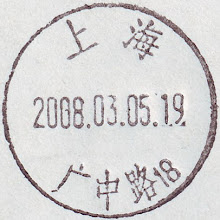
 Those FDCs were sent to my Lithuania friend on issue day by registered mail. There are 2 special cancellation on the FDC, top one is China special cancellation, bottom one is Shanghai special cancellation.
0
Comments
Label:
China
Monday, October 8, 2007
Russia Flora FDC
 Russia FDC
Name: Flora (Russia - D.P.R. Korea Joint Issue)
Issue date: 2007 September 26th
Design:
1 2
3 4
1. Gladiolus (gandavensis)
2. Iris (ensata Thumb)
3. Rosa (hybrida)
4. Nelumbo (nucifera)
0
Comments
Label:
Joint Issue,
Russia
Japan Post Corporation FDCs

 Japan FDCs
Name: Establishment of Japan Post Corporation
Issue date: 2007 October 1st
In 1st Oct, 2007, the Japan Post public corporation was divided into four private entities — Japan Post Service Co., Japan Post Network Co., Japan Post Bank Co. and Japan Post Insurance Co. — under holding company Japan Post Holdings Co.
Japan Post Service manages the mail delivery services and Japan Post Network controls the post offices and their real estate.
At first, the government will own all of the shares of Japan Post Holdings, with the holding company owning 100 percent of each of the four companies. This means the four will still be funded by the government at first.
As early as fiscal 2010, however, Japan Post Bank and Japan Post Insurance are expected to go public. By October 2017, all shares of the two companies will be traded on the market, while the government reduces its stake in the holding company to about 33 percent.
The two remaining firms — Japan Post Service and Japan Post Network — will not be listed because of their public nature.
0
Comments
Label:
Japan
Sunday, October 7, 2007
Japan Brids FDC
 Japan FDC
Name: Birds - Definitive Stamps
Issue date: 2007 October 1st
Design:
50. Mandarin Duck (Aix galericulata)
80. Oriental Turtle-Dove (Streptopelia orientalis)
0
Comments
Label:
Japan
India CPA Conference FDC
 India FDC
Name: 53rd Commonwealth Parliamentary Conference
Issue date: 2007 September 23rd
The Commonwealth Parliamentary Association was founded in 1911 as the Empire Parliamentary Association. Evolving with the Commonwealth, the CPA in 1948 adopted uts present name, changed its rules to enable all member branches to participate in the association's management and established a separate Secretariat to manage its affairs. Today's resurgence of parliamentary democracy is evident in the growth of the CPA. In the last decade, more than 50 new Parliaments and Legislatures joined or rejoined the CPA.
The Commonwelath is a multi-racial, multi-lingual, multicultural and multi-religious association of sovereign nations spread across all the continents. Despite diversities, the Commonwealth remains a well knit international organization deriving strength from its belief that international cooperation is essential to remove causes of war, promote tolerance, combat injustice and secure development among the people of the world.
The Commonwealth Parliamentary Association is an Association of Commonwealth Parliamentarians who, irrespostive of gender, race, religion or culture are united by community of interest, respect for the rule or culture are united by community of interest, respect for the rule of law and individual rights and freedoms and by pursuit of the positive ideals of parliamentary democracy.
The theme of the 53rd CPA Conference is 'Delivering democracy and sustainable development'. Eminent Parliamentarians from across the Commonwealth will deliberate on the theme's broader perspective for evolving consensus on issues confronting us today for the benefit of mankind as a whole, as well as for the common benefit of the countries in the Commonwealth.
Department of Posts is pleased to issue a postage stamp comememorating the 53rd Commonwealth Parliamentary Conference.
0
Comments
Label:
India
Wednesday, October 3, 2007
Japan Letter-Writing Week FDC
 Japan FDC
Name: International Letter-Writing Week 2007
Issue date: 2007 September 28th
The stamps depict three of "Fifty-three station of the Tokaido Road (Hoeido edition)" by Hiroshige (1797-1858), ukiyoe artist in the late Edo era. These are in possession of Hiraki Ukiyoe Museum. Hodogaya is in Kanagawa, Arai is in Shizuoka, and Kusatsu is in Shiga.
Design:
1. Hodogaya (Kanagawa)
2. Ari (Shizuoka)
3. Kusatsu (Shiga)
0
Comments
Label:
Japan
Taiwan Sending Feelings FDC
 Taiwan FDC
Name: Sending Feelings
Issue date: 2007 September 28th
Based on the theme of "sending one's feelings," the stamp features a pigeon carrying a letter sealed with a heart to convey the idea of "spreading love." It aims to encourage people to put their caring, gratitude, or best wishes into handwritten words and to post them to the persons with whom they want to communicate most through the hands of "green-clothed angels."
1 Comments
Label:
Taiwan
Tuesday, October 2, 2007
Malaysia State Emblems M/S FDC
 Malaysia Minisheet FDC
Name: State Emblems of Malaysia
Issue date: 2007 September 25th
The National and State Emblems is a symbol of pride to the people of a tate or nation. Each symbol in the emblem has its own specific meaning.
Designs: 2nd Row, From left to right.
Detail of 1st row...
Kingdom of Perlis
The wreath of paddy represents the primary occupation and main product of the State. The shield represents the pride and symbol of honour of the State as a rice granary.
Sultanate of Selangor The crescent and the star signifies Islam, that is the State's official religion. The red spear in the centre with a short keris to the right and a long keris to the left are part of the State regalia. The Jawi writing reads the state motto, 'Under the protection of Allah'. Below the phrase appears the broad belt (tali bengkung) or sash worn at the waist by warriors in the past.
Sultanate of Terengganu
Crescent and star symbolizes Terengganu as an Islamic state. The crown symbolizes the sovereignty of the King and the sword, mace and the long keris signifies the state's royal regalia. The Quran is placed on the right to represent Islam as the official religion, whilst the The Book of Law placed on the left signifies justice. The Wali or Selampai is to denote part of the state's cultural regalia.
Sarawak The Bunga Raya (Hibiscus) that is the national flower of Malaysia, is positioned on the right and left side of the Kenyalang bird. The banner underneath the Kenyalang bird's feet carries the new State motto: 'Bersatu, Berusaha, Berbakti' (Unity, Industrious, Dedicated). On the bird's chest is a shield bearing the state colours namely black, red and yellow.
Pulau Pinang
The areca tree (pokok pinang) gave the island its name. The Penang Bridge is not only a source of pride to the people of Pulau Pinang; it also unites the island with mainland part of the State, as well as symbolizing the unity between the state and the federation. The two pillars of the bridge stands for two basic features of the New Economic Policy, namely the eradication of poverty and restructuring of society, while the four cables represent the four major races in the nation, that is the Malays, Chinese, Indian and others. The five blue and white waves symbolize the five principles of the Rukun Negara (National Principles) and the five administrative districts of the State.
Sabah The two arms symbolize unity and cooperation among the State's multi-racial community for progress and success of the country. The five colours represent the five divisions in the State. Zircon blue symbolizes peace and tranquility, white – purity and justice, chilli red – courage and conviction, light blue – unity and prosperity and royal blue denotes strength and cooperation. The silhouette shape of Mount Kinabalu is a symbol of the State of Sabah. The state motto reads "Successful Sabah" on the red scroll.
Melaka
The various colours are the colours of the Federated States of Malaysia and indicates that the Malacca is part of the Federated States. The five keris represents five warriors who are well known for their bravery in ancient Malacca: Hang Tuah, Hang Jebat, Hang Lekiu, Hang Lekir and Hang Kasturi. The crescent moon and star in the middle of the top section are the symbols of Islam, the official religion of the State. The Melaka tree, placed in the centre is the tree from which the State derived its name. The two mousedeers supporting the shield serve to recall the incident involving the mousedeer, which led the first ruler of Malacca to choose the site and formed his empire. The state motto on the blue scroll reads "Unity is Strength".
0
Comments
Label:
Malaysia
Thailand-Japan Joint Issue FDCs


Name: 120th Anniversary of Japan-Thailand Diplomatic Relations(Japan - Thailand Joint Issue)
Issue date: 2007 September 26th
Design:
1. The statue of demon at the Emerald Buddha Temple
2. The Five-storied Pagoda in Nikko Toshogu Shrine
3. Mother-of-pearl inlay work on the soles of the reclining Buddha in Wat Pho, Showing the 108 auspicious signs.
4. A Dragon pattern on the Gagaku costume
5. Thai orchid
6. A cherry blossom
7. Thai female dance
8. Kabuki
Japan consists of approximately 3,900 islands, both large and small. Among these, there are four main islands' Hokkaido, Honshu, Kyushu and Shikoku. The relationship between Thailand and Japan dates back hundreds of years but their diplomatic relationship was established on September 26, 1887. The coorperation between the two nations has included social, economic and political elements. At present, approximately 50,000 Thais reside in Japan and about 36,000 Japanese live in Thailand.
To celebrate the 120th anniversary of the Thai-Japanese relationship this year, the goverments of both countries have agreed to organize various activities all year round. Some examples are the presentation of Thai pavillion as a gift to Ueino Park in Tokyo, the organization of Thai Festival in Yoyoki Park in Tokyo and Japan Festival in Bangkok.
0
Comments
Label:
Joint Issue,
Thailand
Thailand-Japan Joint Issue M/S FDC
 Thailand Minisheet FDC
Name: 120th Anniversary of Japan-Thailand Diplomatic Relations(Japan - Thailand Joint Issue)
Issue date: 2007 September 26th
Japan consists of approximately 3,900 islands, both large and small. Among these, there are four main islands' Hokkaido, Honshu, Kyushu and Shikoku. The relationship between Thailand and Japan dates back hundreds of years but their diplomatic relationship was established on September 26, 1887. The coorperation between the two nations has included social, economic and political elements. At present, approximately 50,000 Thais reside in Japan and about 36,000 Japanese live in Thailand.
To celebrate the 120th anniversary of the Thai-Japanese relationship this year, the goverments of both countries have agreed to organize various activities all year round. Some examples are the presentation of Thai pavillion as a gift to Ueino Park in Tokyo, the organization of Thai Festival in Yoyoki Park in Tokyo and Japan Festival in Bangkok.
0
Comments
Label:
Joint Issue,
Thailand
Monday, October 1, 2007
Japan Greetings International FDC
 Japan FDC
Name: Greeting International, Japan - Thailand Joint Issue, 120th Anniversary of Japan - Thailand Diplomatic Relations
Issue date: 2007 September 26th
0
Comments
Label:
Japan,
Joint Issue
Sunday, September 30, 2007
Malaysia State Emblems FDC

 Malaysia FDC
Name: State Emblems of Malaysia
Issue date: 2007 September 25th
The National and State Emblems is a symbol of pride to the people of a tate or nation. Each symbol in the emblem has its own specific meaning.
Designs: 1st Row, From left to right.
Emblem of Malaysia
The National Emblem (Coat of Arms) of Malaysia (Jata Negara in Malay) consists of a shield guarded by two tigers. On the top of the shield is a yellow crescent with a 14-pointed star. A banner with the phrase "Unity is Strength" (Bersekutu Bertambah Mutu) written in both romanized Malay and Jawi is located below the shield. The original English words were replaced by Jawi some time after independence.
The yellow colour of the crescent and the star symbolises the country's monarchy. The crescent also represents Islam as the official religion while the star represents the thirteen states and the federal territories of Malaysia. (See also Malaysia's Federal star.) Originally, the fourteen-pointed star represented the original fourteen states of Malaysia, which included Singapore. It was not changed when Singapore left the federation, but it has generally been accepted that the 14th point represents the Federal Territories. More….
Sultanate of Kedah The wreath of paddy symbolizes agriculture, the States principle commodity. The red background colour is the traditional colour of the State, signifying prosperity. The crescent symbol signifies Islam while the shield symbolizes the role of the Sultan as the protector and guardian of his subjects.
Elective Monarchy of Negeri Sembilan
The nine stalks of  rice on the shield represents the nine states in the federation of the Old Negeri Sembilan. The red colour in the shield reflects the past British connection. The black colour denotes the Datuk-Datuk Undang Yang Empat and Tunku Besar Tampin, whereas the yellow colour signify the Yang di-Pertuan Besar. The sword and its sheath above the shield represent justice whereas the 'Changgai Puteri' between the sword and its sheath represent the sovereignty of the Ruler.
Sultanate of Pahang The spear head that incorporates the design of the coffee leaf, with the word 'Negeri Pahang' was originally gold in colour including the staff and guard. The reason for the choice is that in 1862, gold is the number one produce in the state of Pahang. Also in the old days, it was said that nothing can stand against weapons or weapon heads made of gold. The pair of elephant tusks criss-crossed against each other in front of the spear/coffee leaf signifies the abundant existence of elephants in the state. The inclusion of 'Ya La Tif' implies that the state will be ruled and governed in soft and subtle ways that will be a blessing to all its citizens.
Sultanate of Kelantan
The crown stands for the sovereignty of the State while the two spears and two keris signifies the power of the Kelantan Malays. The symbol of the star and crescent signify Islam. The two cannons signify that the State is always ready to defend itself. The two deers serve as reminders of the period in the State's history when Che Siti Wan Kembang, the Queen of Kelantan (at the end of 14th century), ordered the State's gold coins to be stamped with the image of these deers for which she held such deep affection. The State motto reads 'In God, the Government of Kelantan Submit'.
Sultanate of Johor The crown denotes the Ruler. The four stars at the corners of the white shield stands for the four original districts of the State, namely johor Bahru, Muar, Batu Pahat and Endau, while the star and crescent signify Islam. The two tigers recalled the period when wild beasts roamed the State. The floral decorations below the shield represent gambier and black pepper, the two main produce of the State. The State motto reads 'In The Hands of Allah'.
Sultanate of Perak
This crest which is worn by the Ruler on his headdress symbolizes his sovereignty. The crescent signifies Islam as the official religion, whereas the paddy flower stands for the primary occupation and main produce of the people and the State.
Detail of 2nd row...
0
Comments
Label:
Malaysia
Indonesia University FDC
 Indonesia FDC
Name: The 50th Anniversary of Universitas Padjadjaran
Issue date: 2007 September 11th
Design:
1/4: Nature of West Java
2/4: Legend of Padjadjaran Crown
3/4: UNPAD Building
4/4: UNPAD Vision & Mission
Universitas Padjadjaran was founded upon initiatives of prominent leaders of West Java who recognized the urgency of a higher educational institution for young generation being prepared to serve as future leaders of Indonesia. Soon after the implementation of Asian African Conference in Bandung in 1955, the support from the government encouraged the leaders to form a committee for the development of public university in Bandung. With thir hard work, on August 14, 1956, a committee fro the establishment of public university named Panitia Pembentukan Universitas Negeri was created with Prof. Mr. H. Moh Yamin as the chief of the committee. After a thorough process, on September 11, 1957, a government regulation stating the official establishment of the university marked the beginning of the university which was inaugurated by President Sukarno in the same year.
Universitas Padjadjaran simultaneously strives to be the leading university in Indonesia and seeks to achieve a national and international academic standard committed to the truth and excellence in mastering, developing and applying science, technology and arts based on an academic platform characterizing the university which empowers law and environment, known as “Bina Mulia Hukum dan Lingkungan Hidup”. Furthermore, the university has a mission to undertake an efficient and effective management to educational process, research and dedication to society and to produce high qualified graduates.
To mark the 50th anniversary of Universitas Padjadjaran (or Padjadjaran University), a stamp series is issued on 11September 2007. The series consists of four stamps showing the chronological sequences and the environment of the university which is located in Bandung, the capital city of West Java Province.
The animals and plants depicted on the first stamp symbolize the biodiversity of West Java. The second stamp shows the former kingdom once ruled in West Java, Padjadjaran, from which the university derived its name. The building depicted on the third stamps is the center and old campus of the university, before it has new campus outside the city whose gate appears on the fourth stamp along with the symbols of vision and mission of the university.
0
Comments
Label:
Indonesia
Saturday, September 29, 2007
Taiwan Ancient Painting M/S FDC
 Taiwan Minisheet FDC
Name: Ancient Chinese Painting "Eighteen Scholars of the T'ang" by Emperor Hui-tsung, Sung Dynasty
Date of Issue: 12 September 2007
More detail of this issue
2007 Taiwan Ancient Chinese Painting FDC (Eighteen Scholars of the T'ang)
2007 Taiwan Ancient Chinese Painting Minisheet FDC (Eighteen Scholars of the T'ang)
2008 Taiwan Ancient Chinese Painting FDC (A Hundred Deer)
0
Comments
Label:
Taiwan



 Posts


